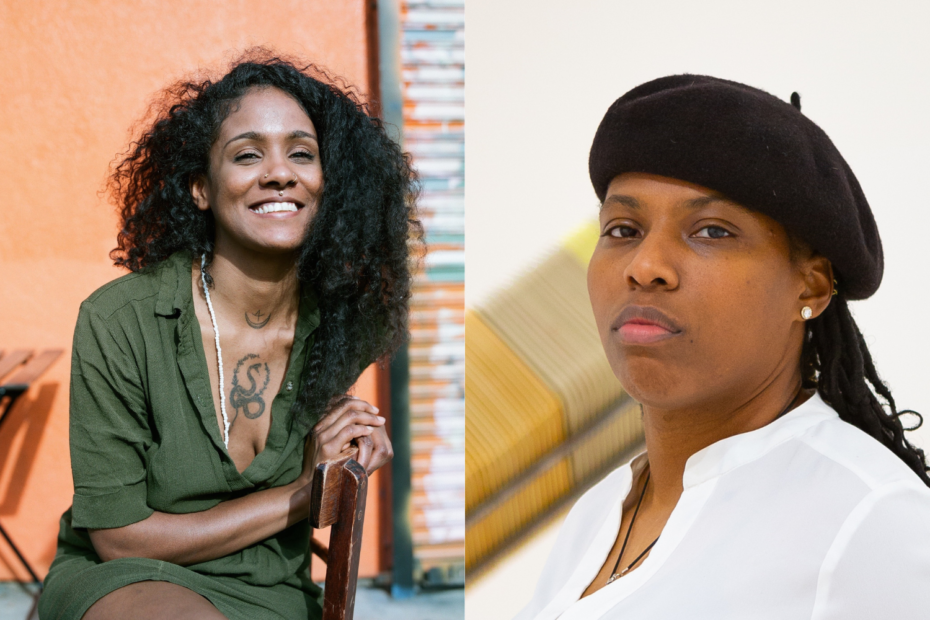
S.O.U.R.C.E. Studio’s 2022 Corrina Mehiel Fellows, brontë velez and Mary Enoch Elizabeth Baxter, sat down recently for a fellow-to-fellow interview. They explored how systems of care converge and diverge, and the paradoxes of being in practices of enacting care while legacies of extractive and toxic care still remain.
At SOURCE we’re constantly revisiting what it means to pursue and embrace care as an organization, in our lives and our personal communities. Likewise we honor how our fellowship opportunities and nimble network continue to shape, inform, and embody our work as an organization.
Throughout the conversation, Mary and brontë referenced (what felt like it could be an infinite) list of people, viral videos, articles, and artists as evidence, to the wisdom they shared. Here, they’re placed to the side but don’t skip over them! We hope they’re fuel for your own search for care, justice, and a right relationship to the world.
brontë – I’m thinking about us sitting around the table one night in North Carolina, and your beautiful and loving read against museum culture. You navigate so many worlds, there’s this interface you have with your work that navigates the museum, violence, carcerality and forms of exploitation. I’m curious how you trick using the museum space for yourself. How do you reconcile?
Mary – It’s ongoing. With a lot of systems of oppression and historical sites of violence and extraction, they’re always mutating, they’re always reorienting and readjusting. That keeps you in a state of always having to realign your values when they come in with the misalignment. I think it’s fundamentally knowing and being clear on who you are before you even engage in those spaces.
For a lot of artists, especially if you’re coming from these unrecognized, marginalized spaces– you don’t know what you don’t know. You’re hungry for opportunity, you’re hungry to share your voice, but they are just as hungry and desperate to appropriate it and utilize it for their own means, so you have to be very clear about those boundaries. It is very violent, very draining dealing with folks that can’t see themselves or refuse to see themselves.
More from Mary on appropriation and the continuous fight for repatriation:
Read:
“Denver Art Museum Denies Repatriation Requests from Native Alaskan Tribes: Report” Karen K. Ho in Art News, April 23, 2024.
“Nigeria Debates the Fate of Returning Benin Bronzes” Noah Anthony Enahoro, New Lines Magazine, April 2, 2024
“Chairs of Harvard’s Legacy of Slavery Memorial Committee Resign Over Timeline Disagreement” Neil H. Shah, Harvard Crimson, May 30, 2024.
brontë – Mary, your practice in and of itself is a practice around care— caring for the archive, caring for memory, caring for ancestors, caring for children, caring for yourself as a child in some way in that care that you do across time. I’m curious about how that care work inherently protects your integrity as you interface? How does it firm you up and fortify your direction? How do you stay true to yourself?
Mary – I think it’s the experience. It’s the experience of knowing what you don’t want and being brave and courageous enough to recognize how powerful the ‘no’ is. You might be saying no to an opportunity now but yes to your integrity will also create that vortex. But that portal where the right people and the right places will align and gravitate.
Yes, it’s murky waters. Just because I’m all of my different racialized and gendered identities, the communities I grew up in, the certain class I grew up around, there was so much overlapping violence and then the remedy towards that violence was always this thing around care. My incarceration was around rehabilitation and care, but yet, I experienced being shackled for over 43 hours while in labor with my child. Trying to reconcile those things you have to really dig deep and question what is care, and I think that’s how I arrived at thinking deeply and nuanced and in these complex ways about care.
Mary and brontë on the history of care in colonization:
Read:
“Meet Mary Enoch Elizabeth Baxter” Interview with Abigail Glasgow, Passerby Magazine
“We’re relying on systems and people that historically have shown us that they don’t know how to care. And until we address those root causes we’re always going to be going in this loop.”
Mary Enoch Elizabeth Baxter
Mary – one thing I love about brontë is that they always come with care. It’s in their language, it’s in the way they facilitate community, build community in their own life but also how they bring in others, especially in the collaborations that they do– they’re all centered in care. Tell me a little bit more about what brought you to this framework not only for others but also yourself.
brontë – I think so much of my work is trying to grapple with the legacies of the plantation and its relationship with black folks’ connection to the land. That’s where I find we can let go of a lot of it and let something much bigger care for us– ask the land to care for us in a consensual way.
I think sometimes there’s an idea, an assumption, that the earth will just take care of us. Whereas I see with climate collapse it is this rebellion against non consensual requests for care. There’s this assumption that as your mother you’re just supposed to take from me— but maybe I’ve already weaned you.
Thinking about the images of the plantation I’ve seen and black women who are lactating having white babies on them. And hearing stories of women needing to go right back to work after giving birth.
Mary – And it’s interesting because it’s still happening, right? It’s a paradox because on one end there’s this narrative that black women don’t care about their children. The ‘crack whore’ the ‘welfare queen.’ ‘She’s negligent.’ But you go to a park in any major city and there’s black women, brown, indigenous women, doing the same work, doing the same labor.
There’s this thing on one end ‘we suck at being mothers’ and on the other end our labor, our care is constantly extracted in the workplace or in these caregiver positions.
I love what you said about this relationship between the earth and the fact that there needs to be this proactive approach. You’re in relationship to the land, the land is not doing everything for you and it makes me think of this new intersection and this new way I’m looking at reproductive justice and connecting that with reconnecting with the land.
More from Mary and brontë:
Read:
“The World is a Womb” The closing event for Mary’s show ‘Ain’t I a Woman’ at the Brooklyn Museum, August 12, 2023.
“Black Reconstruction in America” W.E.B. Du Bois
brontë – I think about the people in my life and in my community who are European descendants who are practicing the rooms, who are divining with their ancestral traditions, who are re-recovering celtic rights and practices and storytelling and learning their languages and going back to land practices.
I feel like the desire for appropriation, that ‘we’re holding onto these artifacts’ is that story of ‘I don’t have my own culture, I don’t have something that can bring me into my own community and my own spirit’ I feel like when we touch that in our own traditions it’s really powerful.
brontë recommends:
Morgan Curtis and Justine Epstein’s work, Ancestors and Money
Aurora Levins Morales’ radical genealogy work
brontë – I’ve seen in teaching with Ancestors and Money and caring and Justine’s work, Reckoning and Remedy, they go out on a four day fast to reckon with their relationship to inherited wealth. I know people who are in these programs, gave away all their stuff out of guilt, but didn’t have any community established outside of their affluence, they had nothing to rely on.
I’ve seen the ways in Morgan’s life, she’s committed to redistributing 100% of her inherited wealth and 50% of her income. I’ve seen that she feels that trust to do that because she lives in an anti-capitalist community so she’s not worried about how she’s going to be taken care of. This whole thing about people who have isolated themselves as a form of care, or all their care was transactional. You can’t have your life still.
Mary – That’s exactly like some of the folks I’m dealing with, all their care is transactional. And there’s also this detachment from spirituality and this embrace – you can actually trace some of it to 17th century ‘great thinkers’ and ‘existentialism’ and the thought that none of this really matters so it gives permission to not be responsible, because there isn’t a God. “If the tree fell in the forest and no one was around to hear it, does it really make a sound” All of this detachment from reality so no one has to really reckon with the real consequences of their choices or non-action.
brontë – I’m really with this thing of a person’s belonging being capitalized on, so that they’re able to compensate for that lack of payment through belonging. And also that thing of people having trouble finding awe, the desperation to and desensitization to be numb to miracles.
brontë – I’m curious to close with what’s something recently where you’ve been able to find awe, or how do you access your relationship to awe.
Mary – I’m getting awe out of my family, the little things, making new work.
I just started this new series thats digging into black abstractions and connecting or looking at abstraction as a means of black refusal and a means of protection and the need to obscure black bodies because of hyper surveillance.
Mary’s newest work, Consecration to Moses (Dum Diversas), explores the legacy of Moses Williams, a skilled artist and physiognotrace, enslaved until adulthood by Charles Wilson Peale, co-founder of the Pennsylvania Academy of Fine Arts.
Listen to Mary speak more about the work:
Read:
“Frieze Reframe: Mary Baxter, Maria Gasper and Gary Tyler,” Frieze New York, May 2024.
brontë – My gratitude and my awe is for the way that you love people who in their lifetime were not honored, and the way that you give so much attention to those who have passed on. You’re revealing that there is still time to give and honor and love the memory of people who were not honored in their lifetime. And, just hearing about Moses’s life, the depth to which you’re so intimate with his life and the choices and the questions that you’re asking that were not in the archives.
Mary Enoch Elizabeth Baxter is an award-winning Philadelphia based artist who creates socially conscious music, film, and visual art through an autobiographical lens.
Although it has been a decade since her release from a Pennsylvania prison, Mary’s time spent on the inside continues to shape the direction of her art and practice. Her entertaining but poignant works offer a critical perspective on the particular challenges women of color face when they become immersed in the criminal justice system. Her work has been exhibited at venues including MoMA PS1, African American Museum of Philadelphia, Eastern State Penitentiary, Ben & Jerry’s Factory in Waterbury Vermont, Martos Gallery and HBO’s The OG Experience at Studio 525 in Chelsea among others. Ms. Baxter is also 2017 Soze Right of Return Fellow, 2018 and 2019 Mural Arts Philadelphia Reimagining Reentry Fellow, 2019 Leeway Foundation Transformation Awardee, 2021 Ed Trust Justice Fellow, 2021 SheaMoisture and GOOD MIRRORS Emerging Visionary grantee and 2021 Frieze Impact Prize award winner.

brontë velez‘s work and rest is guided by the call that “black wellness is the antithesis to state violence” (Mark Anthony Johnson). As a black-latinx transdisciplinary artist, designer, trickster, educator and wakeworker, their eco-social art praxis lives at the intersections of black feminist placemaking, abolitionist theologies, environmental regeneration and death doulaship.
they embody this commitment of attending to black health/imagination, commemorative justice (Free Egunfemi) and hospicing the shit that hurts black folks and the land through serving as creative director for Lead to Life design collective and ecological educator for ancestral arts skills and nature-connection school Weaving Earth. they are currently co-conjuring a mockumentary with esperanza spalding in collaboration with the San Francisco Symphony and stewarding land with their partner in unceded Kashia Pomo territory in northern California.
Mostly, brontë is up to the sweet tender rhythm of quotidian black queer-lifemaking, ever-committed to humor & liberation, ever-marked by grief at the distance made between us and all of life—