- March 2nd, 2026
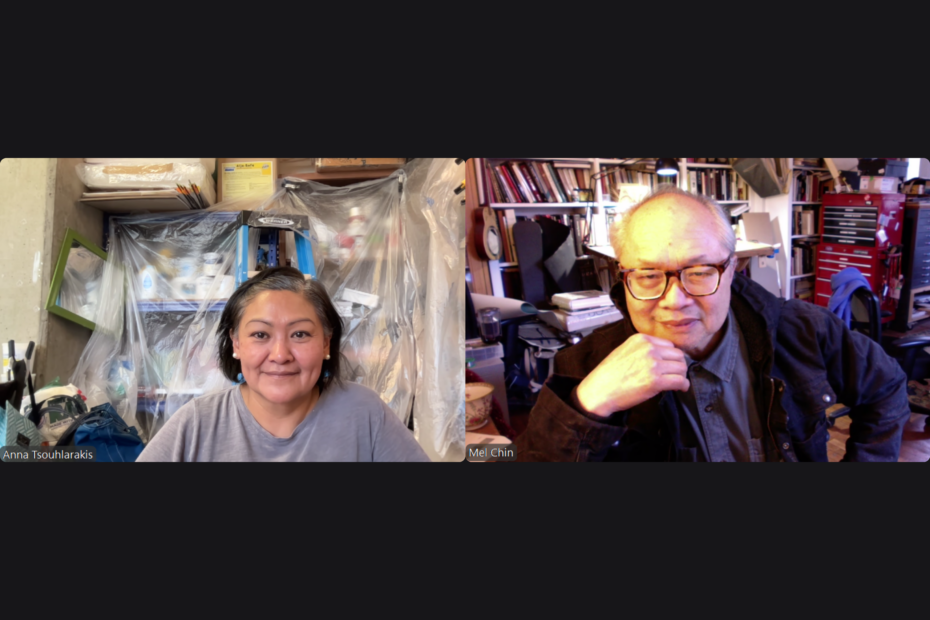
SOURCE Studio founder Mel Chin sat down with artist and 2024 Corrina Mehiel Fellow, Anna Tsouhlarakis, for a deep dive into their artistic practices as Anna prepared her monumental sculpture for the upcoming 2026 Whitney Biennale and Mel worked towards his exhibition in Japan for the Hiroshima Art Prize. In this co-interview and conversation they reflect on their material strategies, on dreams as release valves, and critical moments of refusal in their practices.
. . .
Anna Tsouhlarakis received her BA from Dartmouth College with degrees in Native American Studies and Studio Art. She went on to receive her MFA from Yale University in Sculpture. Tsouhlarakis has participated in various art residencies including Skowhegan School of Painting and Sculpture, Yaddo, MacDowell, and was the Andrew W. Mellon Artist-in-Residence at Colorado College for the 2019-2020 academic year. She was awarded a Creative Capital Grant in 2021, received a 2022 Louis Comfort Tiffany Foundation Award, was a 2025 Smithsonian Artist Research Fellow and in the summer of 2025, she returned to Skowhegan School of Painting and Sculpture as Resident Faculty. In the Spring of 2026, Tsouhlarakis is Artist in Residence at Temple University’s Tyler School of Art and Architecture.
Mel Chin: First of all, it looks like you have plastic covering things in your background, are you splashing around making things for the Whitney Biennial?
Anna Tsouhlarakis: Yes! I made a sculpture called SHE MUST BE A MATRIARCH in 2023 for Indigenous Absurdities, a solo exhibition at MCA Denver. The sculpture has since been acquired by the Hood Museum of Art at Dartmouth College. They wanted the sculpture to be made archival because there are hundreds of blown up condoms in it and latex is not archival. The sculpture had been in storage waiting to be shipped out when the Whitney contacted me, and we decided SHE MUST BE A MATRIARCH would be the perfect piece to go to the biennial since it had only been shown once before at MCA Denver.
I’ve been working on making the piece archival. I’ve coated all of the condoms with three layers of an Epsilon Pro epoxy resin. Every layer has to be sanded like nobody’s business because the resin comes out somewhat lumpy, so that’s why everything in the studio is covered in plastic sheets, because of all the sanding dust.
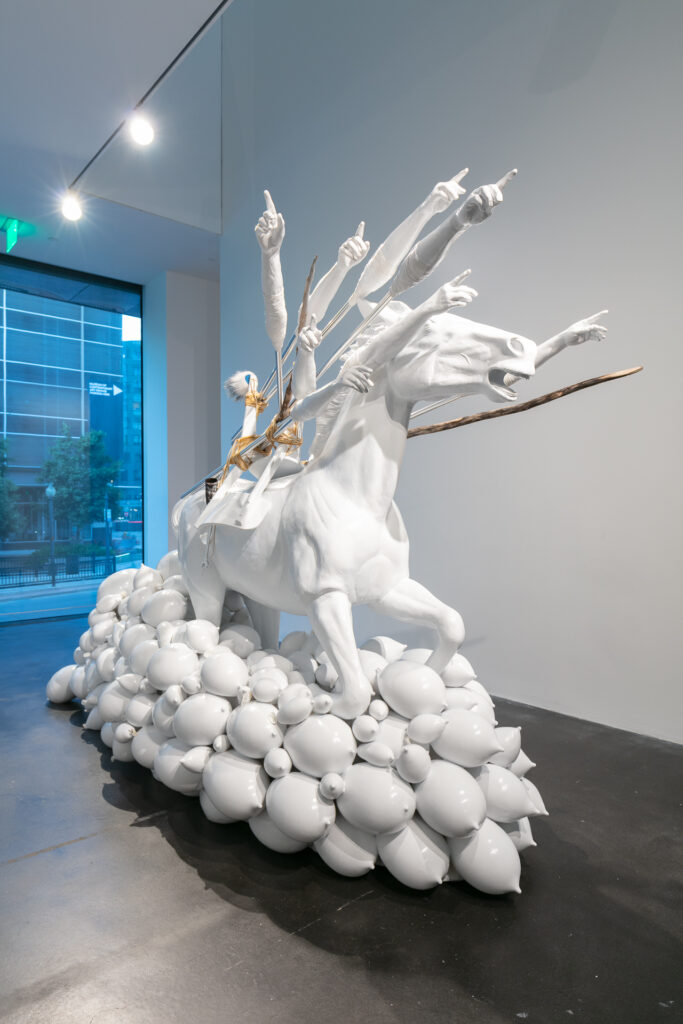
Anna Tsouhlarakis, SHE MUST BE A MATRIARCH, 2023. Fiberglass horse, paint, adhesive, resin, plaster, plastic, wood, foam, metal, IKEA remnants, leather, prophylactics, found objects. 8’ x 15’ x 4’. Photo by Wes Magyar.
MC: What were those condoms filled with?
AT: They were blown up with an air compressor and then we swished liquid plastic around in them to harden the forms. Originally they were only coated with latex paint because I wasn’t thinking about archival-ness when I initially made it.
Another crazy factor I hadn’t initially considered was elevation. Right before bed one night I wondered if the elevation going from 6,500 feet to sea level would affect them. So I sent a friend of mine in Brooklyn a few of these, two I left as is, two I drilled holes in. The ones I didn’t drill holes in completely collapsed like water bottles.
If I hadn’t have realized that, this sculpture would have shown up at the Whitney Biennial completely shriveled up. I had to pull the piece apart a bit more, drill tiny holes in every single balloon and put everything back together.
MC: That happened to me too, the same thing! I was working on a piece that’s now at LACMA, Gate of the New Gods.
The piece was created in honor of Lebron James. It’s a grape vine that was intended to go over the gate at his LA house that someone had written the “n-word” on. He said, it shows no matter how rich or famous you are, you’ll never be free of this country’s racism. So I replicated his gate in steel and then made this arc of basketball grapes with grape leaves out of netting.
It showed at my retrospective at the Queens Museum in 2018. I filled the basketballs with EZ air in the can, you know I used the cheap stuff; but when we were getting ready to place it some of the balls started shrinking. So we had to find a way of getting new basketballs and refilling them. I feel for you.
All this deflation/inflation. The elation is to sell a piece and then the deflation hits when it’s time to deliver and it’s all messed up.
AT: Environmental factors are not something I’ve had to really think about for indoor pieces before. It was shocking to see the photos of the collapsed condom balloons.
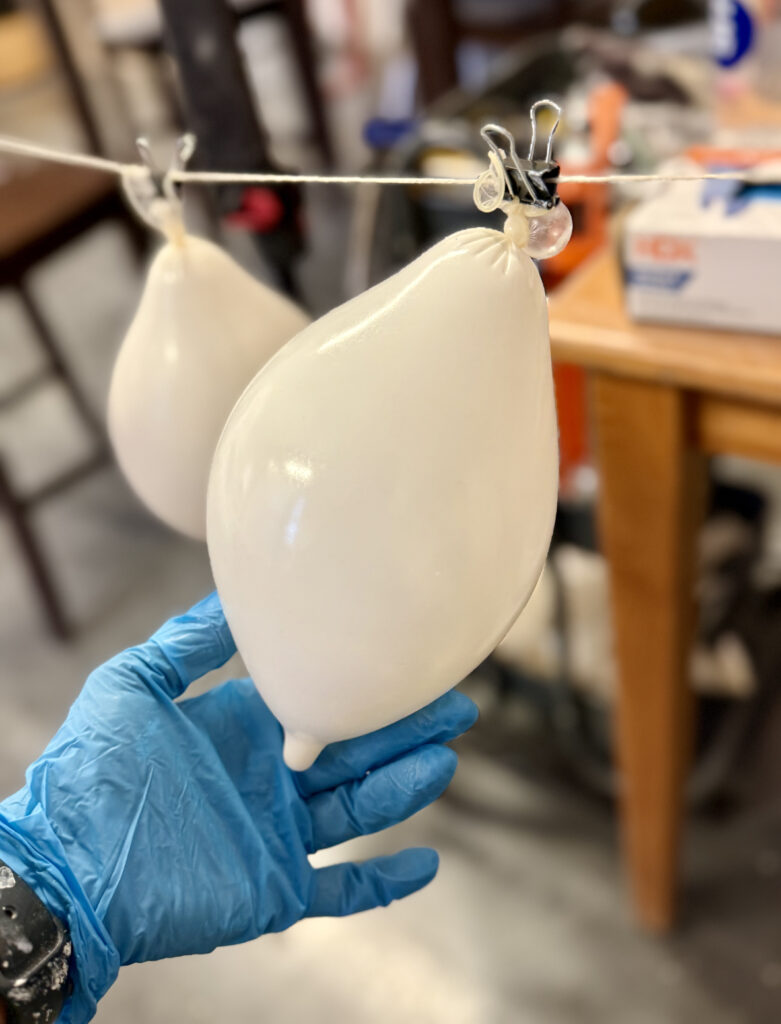
Anna Tsouhlarakis, SHE MUST BE A MATRIARCH, 2023, fabrication process detail shot. Photo courtesy of the artist.
MC: Why condoms? There’s a whole mess of them.
AT: For the whole body of work Indigenous Absurdities I knew I wanted it to center on humor. It eventually expanded into digging deeper into community, raw humor and aggressive humor, and the roasting that happens in community. I decided I wanted to focus on women specifically.
I’ve always been the butt of jokes because I’m the city cousin, I didn’t grow up on the Rez. No matter how I made a certain kind of food or butchered the sheep, no matter if I was keeping up with everyone they were always picking on me. And I knew that was love and I knew it was a connection, it was the way a lot of my family connected with me.
A lot of my work right now is sitting in an exploration of this type of humor and familial connection. SHE MUST BE A MATRIARCH was the biggest culmination of this.
“Reservation Dogs” had just come out at the time and there was this whole movement of younger Native women taking over the idea of the matriarchy, claiming #matriarchmonday on Facebook or Instagram. And yeah, me and my friends would make fun of those girls but it’s also empowering at the same time, it’s this push and pull.
That’s where the name comes from, SHE MUST BE A MATRIARCH, because yeah we would roll our eyes but it’s also this badass movement and moment.
Everything about the work is about female empowerment. There are menstrual cups hanging off the side; there’s a wrench for the rider to throw a wrench in any situation; all of the casts of the arms are Native women’s arms; there’s a chair on the back of the horse turned over, it’s that idea of ‘giving women a seat at the table’ but fuck that I don’t need your chair.
In my mind I wanted to emphasize the movement and motion of the horse with all of the arms outstretched. I was imagining how in Wile E. Coyote and Road Runner cartoons, they would spin in place and take off with a big cloud of dust behind them. I was thinking of balloons at first but we’re talking about materiality. Objects and their connotations are so important and so specific in what I’m using. That’s when I realized condoms could take the place of the balloons because they bring this idea of feminine choice and power. And it’s just kind of goofy.
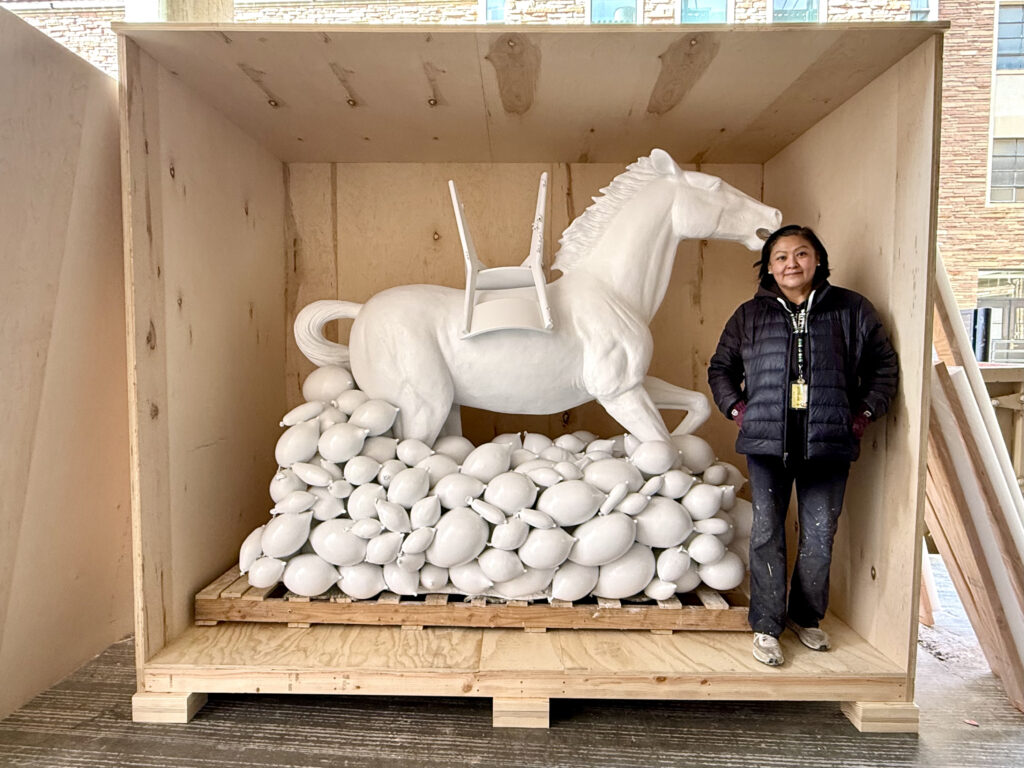
Anna Tsouhlarakis, SHE MUST BE A MATRIARCH, 2023. Photo courtesy of the artist.
MC: Sometimes revisiting a piece is not just about revisiting the concept, but making the whole concept last, not materially falling apart. Conceptually, going back and seeing SHE MUST BE A MATRIARCH again, is it holding the strength for you? It’s an amazing piece.
AT: When the Whitney first approached me, I initially wanted to do a new piece. I want to keep doing these monumental pieces like SHE MUST BE A MATRIARCH.
But I realized that the piece had only been shown once in Denver and for me it’s a seminal work. Something I hope people are going to remember and reflect on.
I have this piece that I love, that I’m really proud of, that I feel will hold up over time so I’ll show this at the Whitney Biennial. And then I have a solo show coming up at Bowdoin College Museum of Art in Maine and I will do a new monumental piece I had in mind there. It’s a continuation of this work.
MC: I remember building one of my favorite pieces about Revival Field, Revival Field Diorama, in the midst of installing for my retrospective at the New Orleans Museum of Art. The show was already up, but I had an idea for one more piece.
So, I’m in the basement at the museum building this piece, I got it finished and loved it to death and said now can we hang it? They said absolutely not.
For years I was trying to get it placed and thankfully the Cantor Arts Center at Stanford bought it. It was one of those pieces where I thought—I really don’t want to sell this. I’m broke but I don’t want to sell it—Do you ever feel that way?
Some things you just want to hang onto.
I recently finished a big oil painting called Revisitation and it was sold to the Art Bridges program. I let it go because they said they would keep showing it. Sometimes when you sell to places they don’t always show it, it may be in storage forever, you never know.
AT: I work with a lot of different mediums but I rarely paint. I did a group of 24 small paintings with geometric abstractions of Native American face paint from movies like “Dances with Wolves” and “Last of the Mohicans.” They look like very serious abstract paintings but they’re actually the actors’ face paint.
They were shown and people wanted to buy them. Someone asked if they bought a group of the paintings would they get a discount, and I said no, you can pay what I’m asking or you don’t. My husband pointed out, aren’t you supposed to want to sell your work, and I said, but these look really good in our dining room right now.
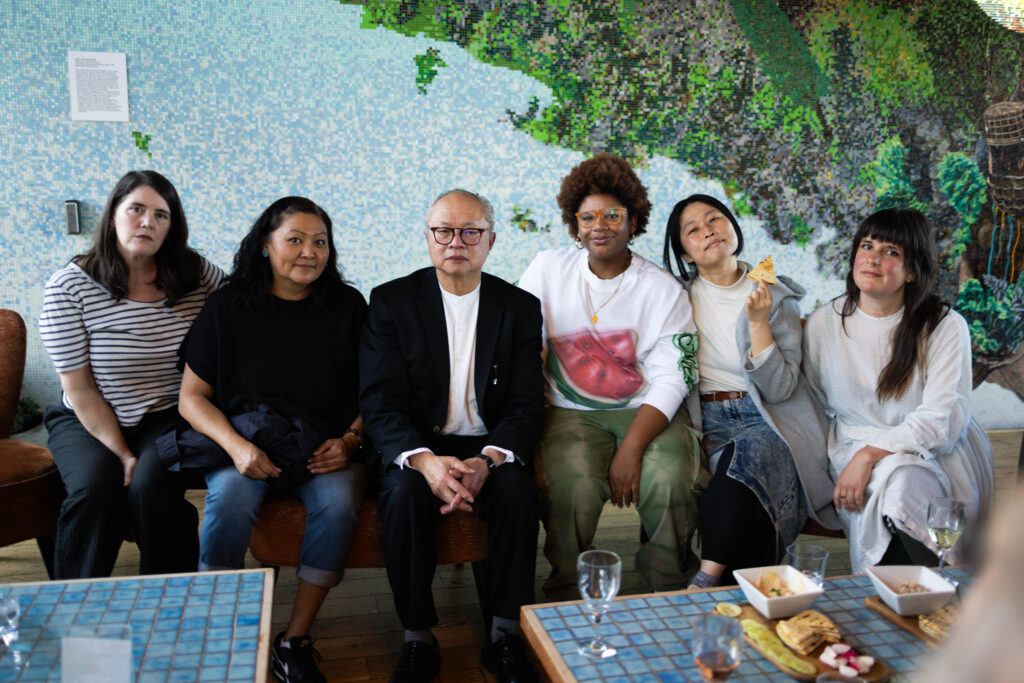
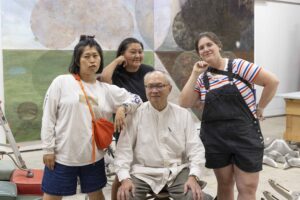
From left to right: Nancy Nowacek, Anna Tsouhlarakis, Mel Chin, Muse Dodd, Naoco Wowsugi, and Amanda Wiles. Photo by Ben Premeaux
AT: You have a show in Japan coming up, how do you prepare? What are you reading? You seem like someone who’s not reading art criticism or theory, what are the things you go back to or start from?
MC: The show is to introduce me as the winner of the Hiroshima Art Prize, it’s a mini survey/retrospective but they also want new pieces.
I started by looking at old Japanese films but the curator also shared some ideas or directions with me. She shared this manga comic, Barefoot Gen, and I started coming up with pieces based on it but they weren’t quite to the edge, you know?
And then, all of a sudden last night in my dream, I had an idea for a work that was supposed to be hot and good but in my dream it didn’t turn out well. I woke up and knew how to make what might be better. It forced me to come to grips. The dream I had provided me with a release: don’t make the piece about what was drawn but about the author himself, Keiji Nakazawa, it should be a homage to him.
This release valve allowed me to start doing research into new things. You should know the history but also dig a little deeper, you never know what new things will be revealed. It’s liberating to digress.
I’ve now been looking at clays. I started with clays in college and realize this sculpture needs to be made with clays and dirt from Hiroshima and transformed through fire. What liberates you sometimes is the poetics of the idea.
Do you see things in dreams or deadlines?
AT: I’m definitely more of a deadline person. I’ve been working towards shows continuously for many years to where I’ve had very little space for making just to make. Anytime I’ve made something it’s for shows which has primed me for project-oriented work and being in the studio and being directed by an idea or theme.
Now I have a lot more going on I find I’m able to ideate quicker while I’m making. In some ways I’m generating more ideas for things I want to do before there’s another project, maybe I’m living in the moment of the studio more intensely.
Last spring, though, I had a show I was making new pieces for and I actually had a dream, which never had happened before, that I was wrapping leather around something and adding porcupine quills to it so they would stick out. I could see it in my dream, I was making it and it felt really cool. The next day I came into the studio and made it and it was cool.
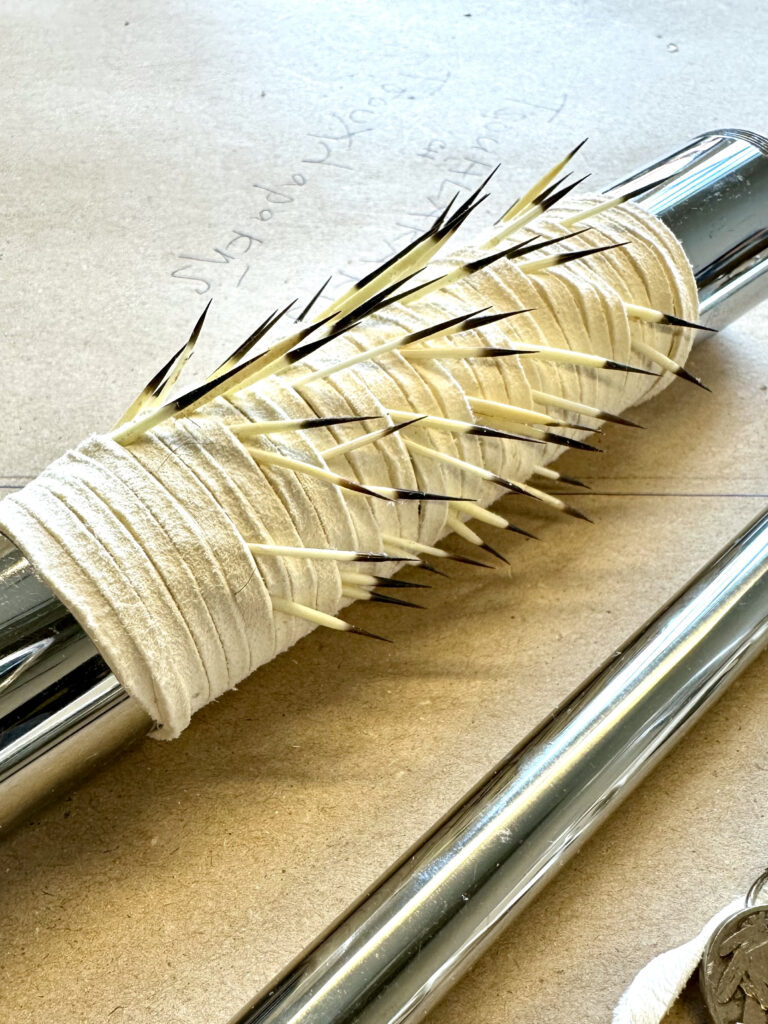
Photo courtesy of Anna Tsouhlarakis.
MC: I find kinship with you around applying historical realities and choosing what form or material you want to use to say it.
There are some insurgencies that you hope you get to accomplish, but you’ve got to get your name off of it. Do you ever get that feeling that if you keep making statements you might become a ‘subject of harassment’?
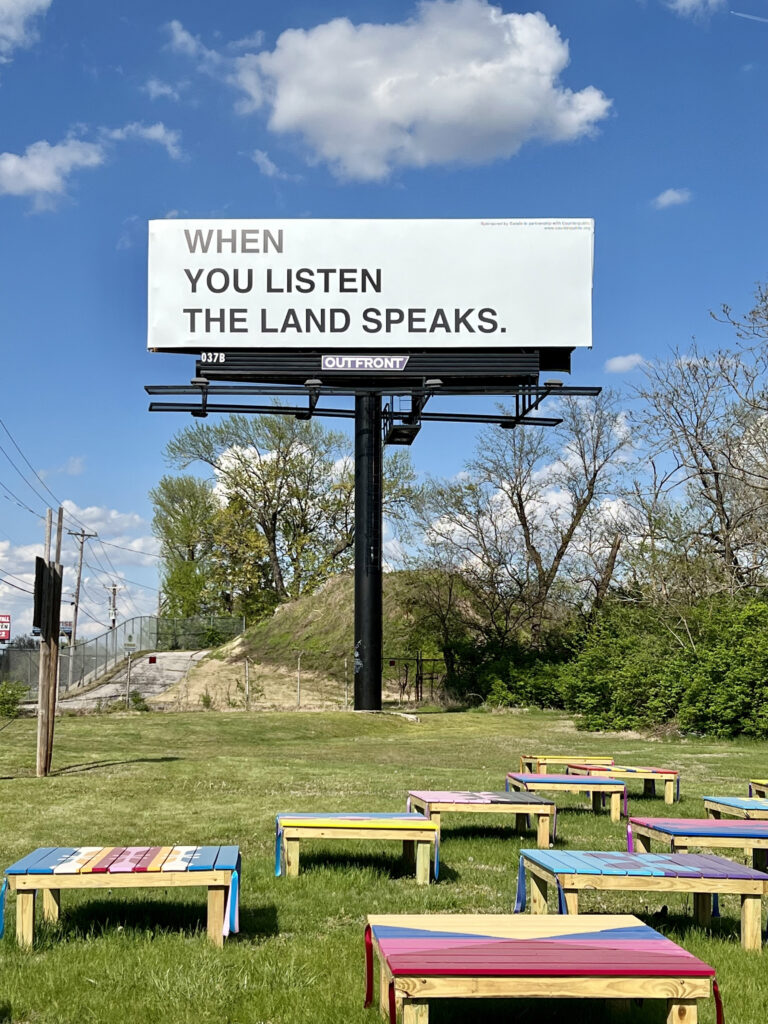
AT: For my big billboards and text pieces for the Native Guide Project, I didn’t put my name on them when I put them out into the world because I didn’t want them to be about me at all.
I know the text I’ve put out into the world has made people mad. I never put it out there anonymously because I was scared, I did it because I didn’t want this to be labelled as artwork by an ‘angry brown woman,’ I didn’t want to give them any filter to have to look through.
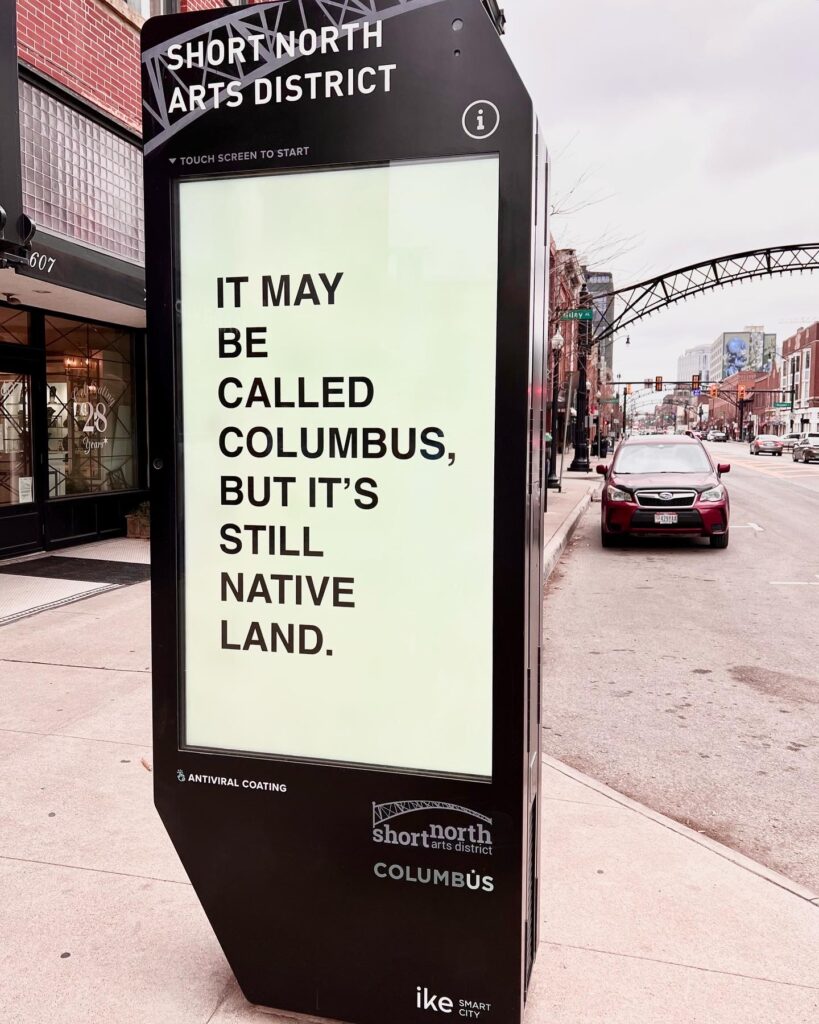
Left: Anna Tsouhlarakis, The Native Guide Project: Columbus, 2023. Photo by artist.
Right: Anna Tsouhlarakis, The Native Guide Project: STL, 2023. Photo by artist.
The first time I ever showed this was as an artist in residence at Colorado College in Colorado Springs in 2019-2020. The local Fox News tracked me down, they said they’d love to do an interview with me about my billboards. I said that would be great and then they said they’d love to have me on camera and I said no, this isn’t about me. This is about my billboards and my artwork. It’s about the text in the world and your response to the text, it’s not about how you and your viewers feel about me. This is about art, the art can be on camera.
They got mad and hung up, but they called me back, the supervisor called me, the head of the station called me, and I refused. I’m not going to be on camera to be the villain you want to create.
MC: I feel you. When the New York Times exposed that Revival Field was rejected for NEA funding I got a lot of calls from news stations who wanted to film it, one said they have a slot for a “giggle” piece. Or, again for Revival Field, Dow Chemical or Dupont called and said they would sponsor the project. I’m not going to be their PR person.
I probably talked to you guys about this at one of our gatherings, but sometimes even the term “art” can be the enemy. When you place a work in another world, like science, although it is also art, it is more readily acceptable.
AT: There’s a small gallery, East Window, here in Boulder and it shows work that’s a bit edgier than the norm around here. I had been reading “Invisible Man” by Ralph Ellison when the gallery owner approached me about having a show in his space. I’d been thinking about how I’m in this very white town and there was a quote from the book, “people refuse to see me” and that became part of the title, YOUR REFUSAL TO SEE: A Native Guide Project.
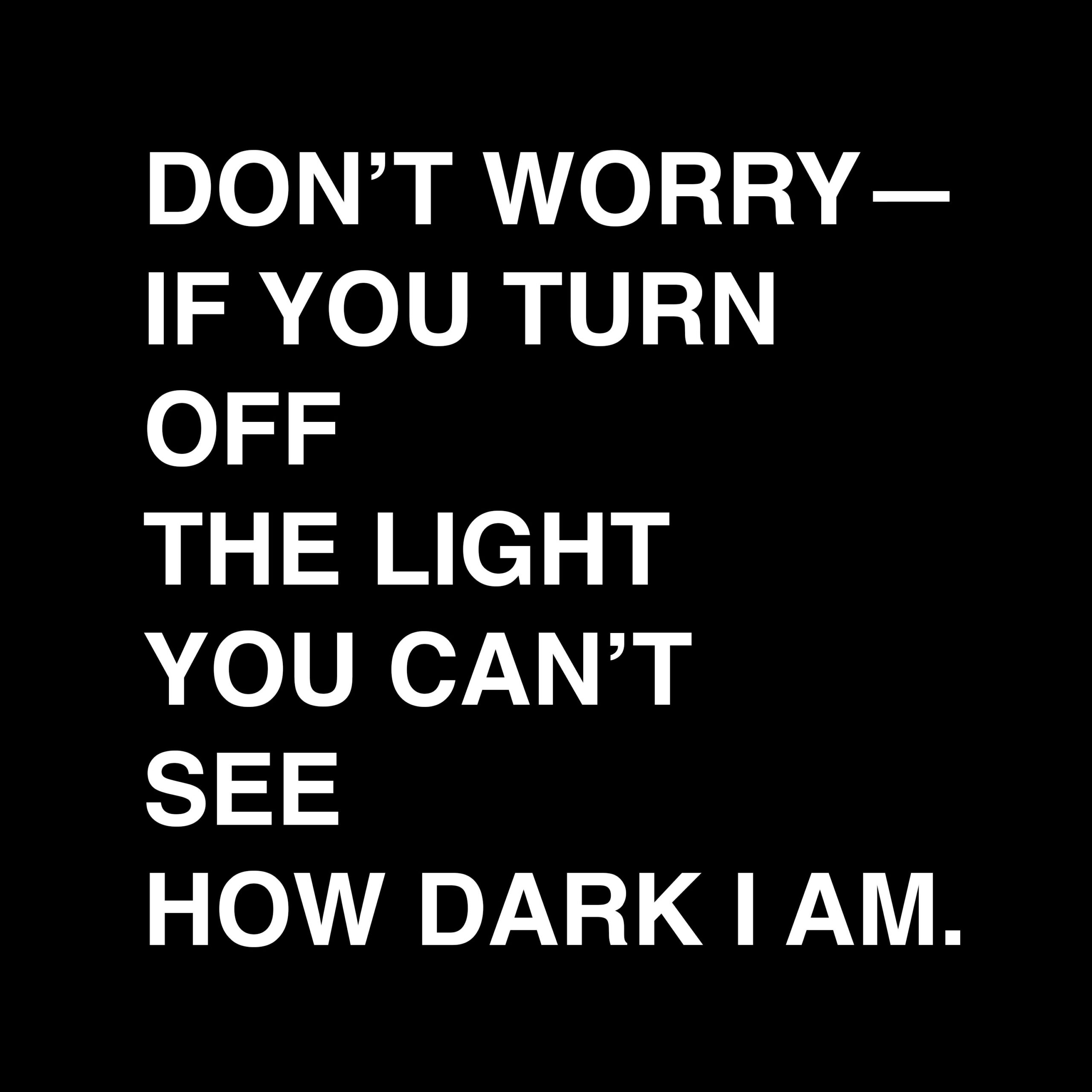

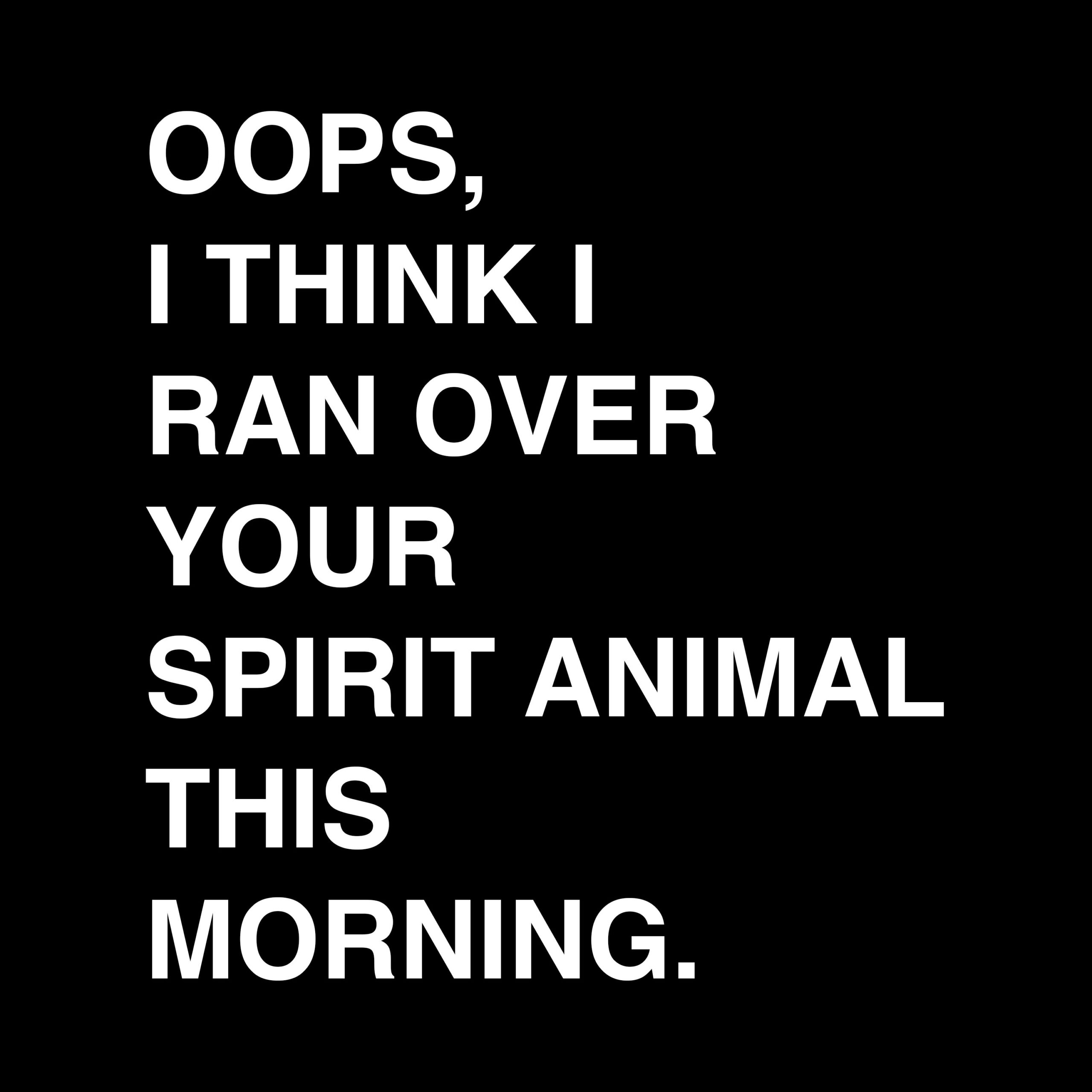
Anna Tsouhlarakis, image selection from YOUR REFUSAL TO SEE: A Native Guide Project, 2025. Images courtesy of the artist.
The text in the show was super direct, some of the most confrontational text I’ve done. I did a talk and people came up to me to say they’d love to have a mural of it painted, and I said absolutely not, I’m not going to be your “good little Indian” that’s going to make it feel like a diverse place. That’s what this whole show is about, it’s not diverse here. I don’t feel welcome, I don’t feel a part of it and I’m not going to let you think I do by putting up a mural of my work.
MC: Yeah it’s not just about your political affiliation, it’s really how you treat others.
AT: I think about Native issues and also what it means to be a Native woman in the world. It’s very different from the experiences of people my same age that live in the same place. These are things that are always part of my thinking and how I frame ideas.
MC: I feel you. No matter how old I get, you think you’ll be old enough to bring respect but there’s no respect to begin with. I’m not talking about amongst friends or colleagues but the wider culture. The racism is embedded within it, you sense it in the harshest ways. You think you’ll never outlive this, so you might as well do some things to mess with it.
To wrap, we asked Mel and Anna what’s one tangible object you always keep with you, that you never want to leave the house without?
MC: I buy these pocket knives and then I look for bones to add onto them. I find different grades of bones, I just cooked up some ham bones, beef bones are the hardest. There’s one that’s a bone from a lamb in Italy.
It’s my good luck cutting tool and I’ve always gotta have it with me.
AT: Besides Lactaid?
I’m a good Navajo, I don’t always have it on my person but I always carry a pouch of corn pollen wherever I am. It’s for blessing, protection, everything. As much as I do out in the world, I never leave my house without it when I’m traveling.
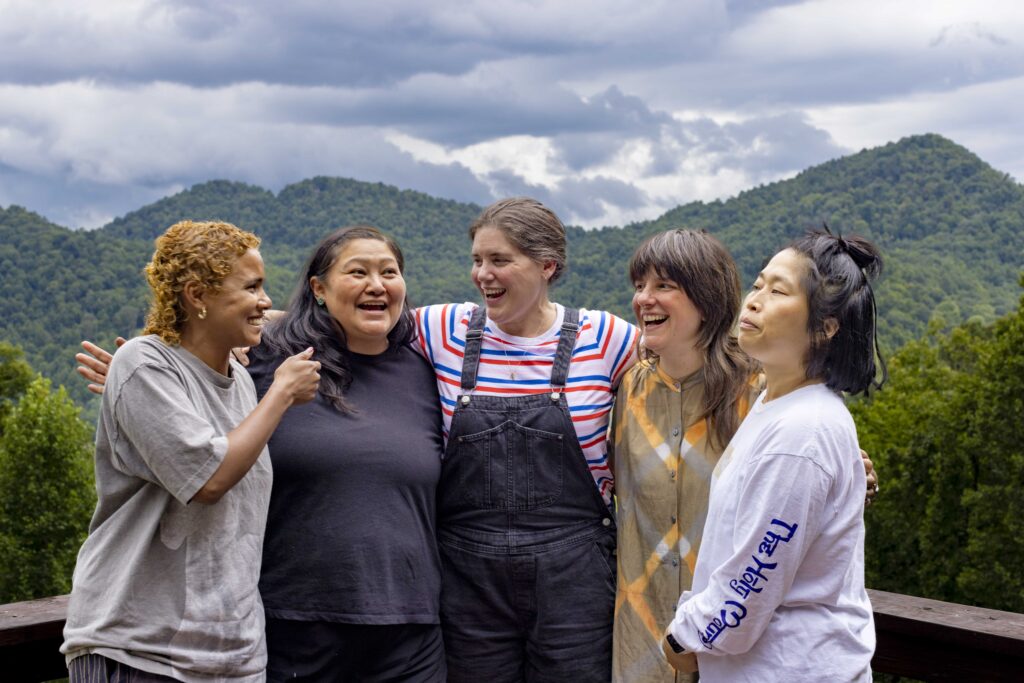
From left to right: brontë velez, Anna Tsouhlarakis, Nancy Nowacek, Amanda Wiles, and Naoco Wowsugi. Photo by Ben Premeaux.
Anna Tsouhlarakis
2024 Corrina Mehiel Fellow Meet Anna: (she/her) Art has always been a presence in my life and over time I found myself asking questions about what Native artists were making and why. There are certain perceptions and expectations that confine Native American Art. I am interested in challenging and stretching the boundaries of aesthetic and conceptual expectations to reclaim and rewrite Native definitions of making through sculpture, video, performance, photography, and installation.