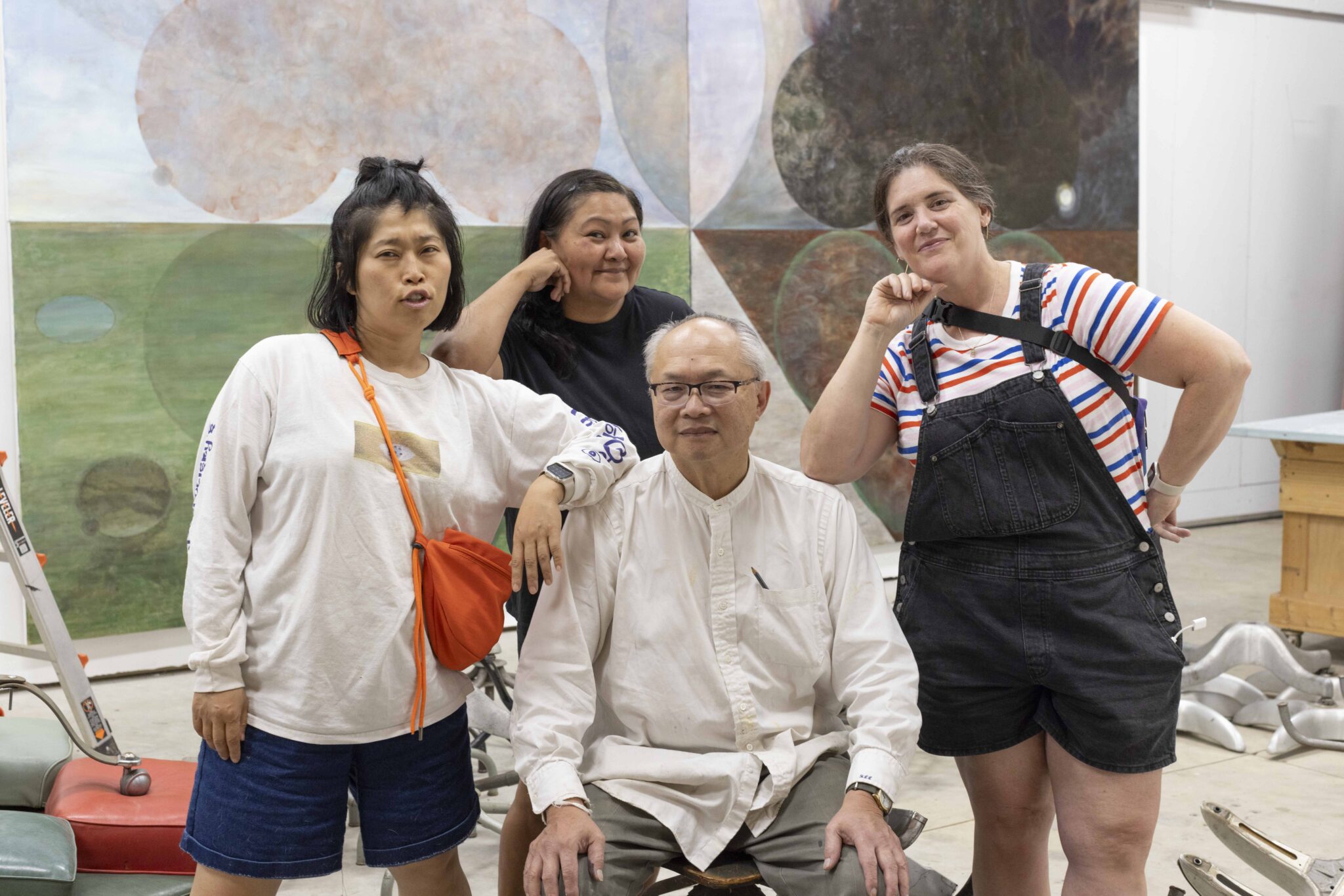
SOURCE Studio—To celebrate the conclusion of Nancy Nowacek’s 2024 – 2025 Corrina Mehiel Fellowship, we commissioned independent curator Jess Wilcox to reconnect with Nancy’s work.
In the essay below, Jess traces a practice that finds movement everywhere, in the body, in nature, through collisions and flows, and across social divides. As Jess concludes, this work “quietly insists that meaningful change begins in the ways we move with and alongside one another.”
We’re grateful to Jess for this generous essay, and to Nancy for being in fellowship with us.
. . .
Nancy Nowacek is an interdisciplinary artist whose practice spans sculpture, performance, and pedagogy. She dissects the power dynamics of social systems and the built environment. And she creates social prosthetics—works that assemble communities to learn, grieve, play, or protest collectively. Many of her projects operate in public space, inviting audiences to reimagine their relationships with the processes and places that govern their daily lives.
Jess Wilcox is an independent curator based in New York City and the Hudson Valley. She has a focus on sculpture, ecocritical and public art. From 2016-2022, she was the Curator and Director of Exhibitions at Socrates Sculpture Park.
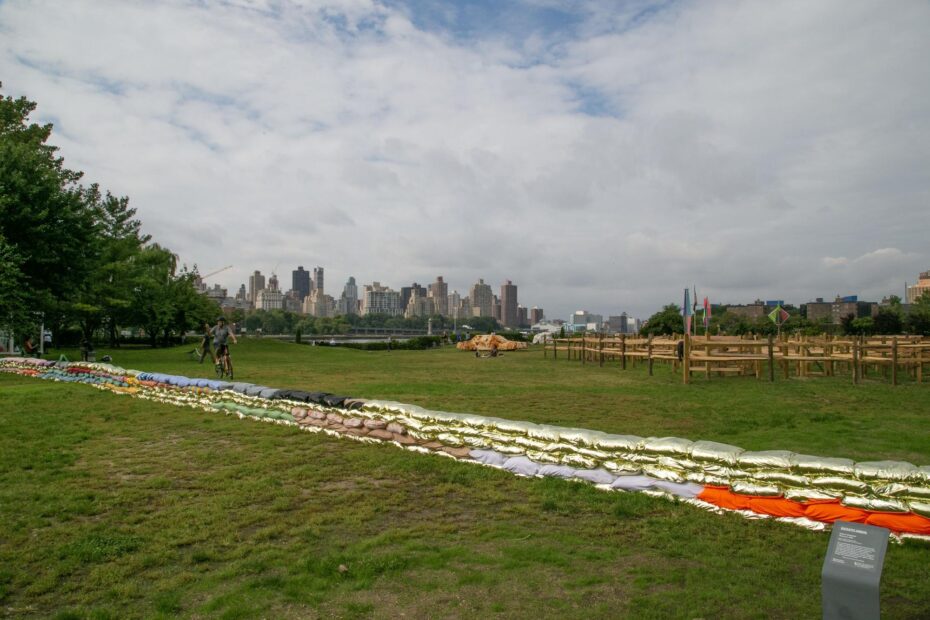
Header image: Nancy Nowacek, Wall, Levy, Beach (Maneuver), 2018-2019. 20,000 lbs of sand, textiles and mylar. Installation image courtesy of the artist.
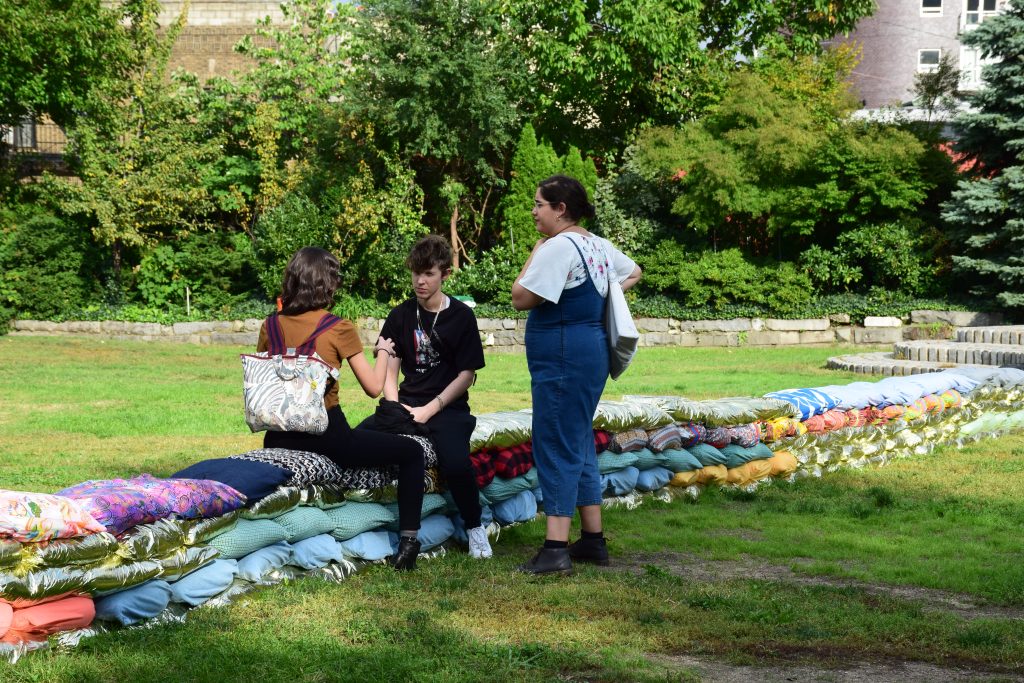
In the early autumn of 2018, a visitor to Socrates Sculpture Park may have immediately noticed Nancy Nowacek’s project Wall, Levee, Beach (Maneuver) as it glimmered gold in the sun. Some 400 sandbags clad in a motley of fabric covers ranging from denim to high-vis orange, from pastel pajama patterns to gold lame. A close approach revealed the shimmering material as mylar, the stuff of emergency blankets distributed during disasters.
Nancy Nowacek, Wall, Levy, Beach (Maneuver), 2018-2019. 20,000 lbs of sand, textiles and mylar. Installation image courtesy of the artist.
The sandbags lay stacked along the grass comprising a low barrier across the middle of the Park. Some regular visitors familiar with the pedestrian desire lines of the landscape were irked by this division through their public green space. I saw some viewers inspect the work, read the accompanying placard for information, then chuckle and hoist legs high over the obstacle. This was no Tilted Arc. At two feet high, the wall doubled as a bench which many took advantage of, resting, lounging, chatting, and often climbing up and jumping off with children.
This was only the first of three configurations of Nancy’s multiform sculpture. In November 2018, Nancy led a Resilience Training event in which over the course of two hours members of the public volunteered to transform the sandbag assemblage from a wall into a levee.
Several of the volunteers were neighborhood locals who had been in the area six years before when Hurricane Sandy inundated 90% of the park. Nancy planned for the height of the levee to reach the water’s 5 foot peak in the Park during Sandy. A father and his elementary school-aged son had never experienced flooding but were participating to be “prepared for the eventuality.” A foursome of college students felt that climate change was the biggest challenge their generation faced and were attracted by the public event’s call to arms.
Since hoisting sandbags is heavy labor, the group organically developed a system to ease each individual’s burden and speed the process. The ends of the walls passed inward toward the growing levee, taking on a rhythm as muscles contracted and released, lungs sucked in deep breaths and the hefty bundles swung to their new place.
The collective decision making on the aesthetics of the levee mirrored the cooperative effort. Someone suggested, “Shouldn’t all the colored bags stand together in opposition to, or against the golden bags?” Others concurred with nods and their own descriptions of the motley crew battling the elites.
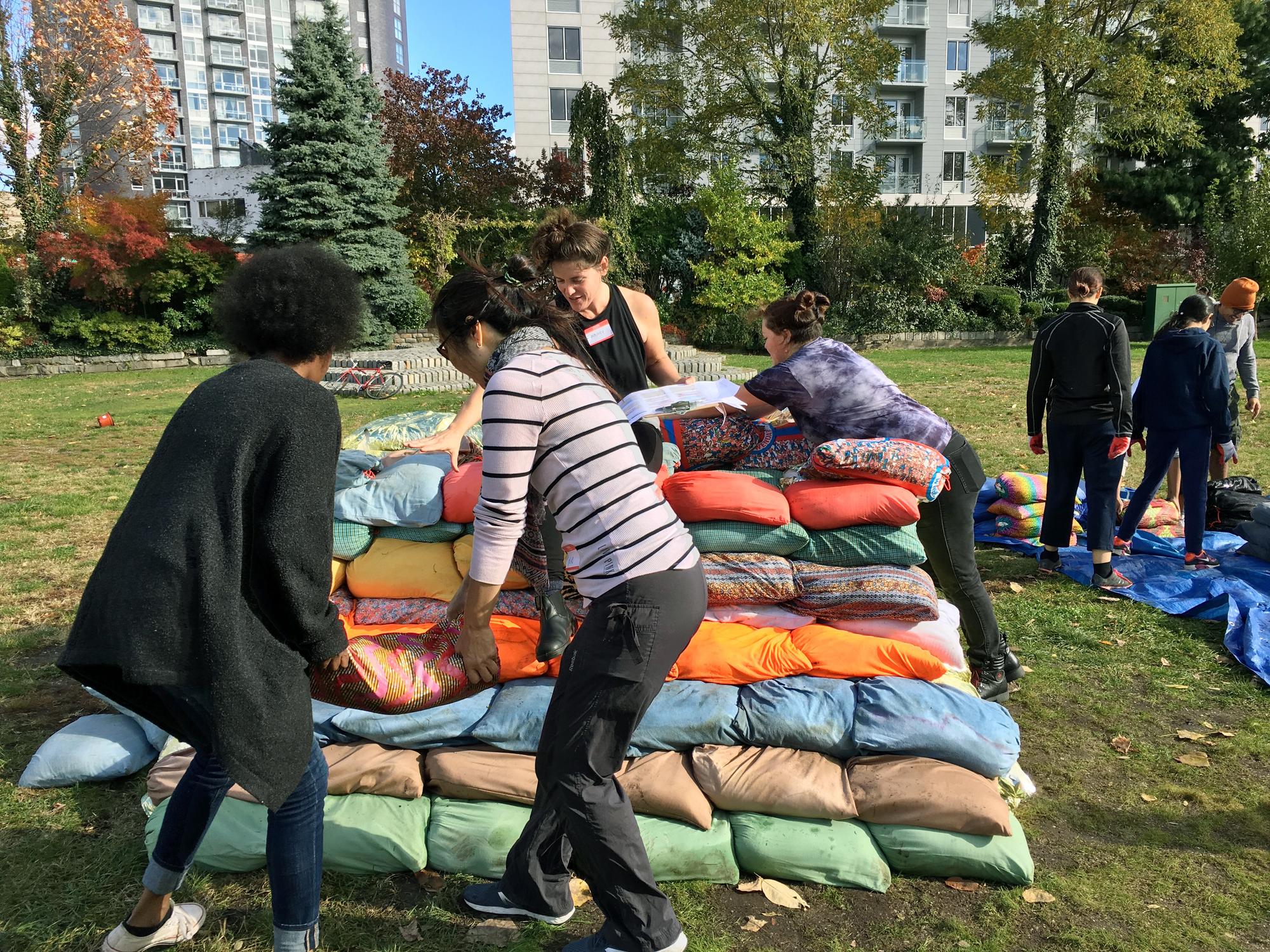
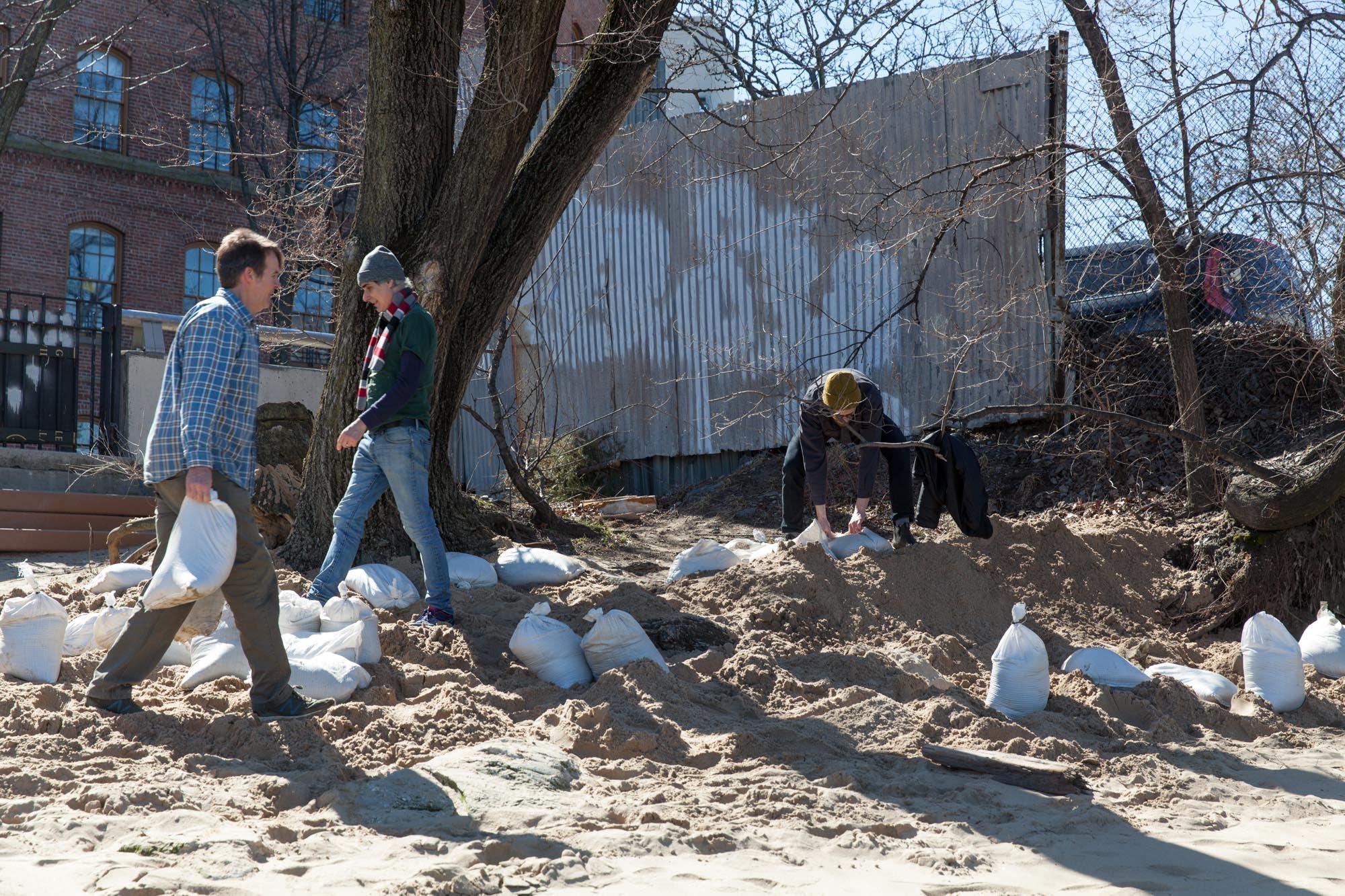
Nancy Nowacek, Wall, Levy, Beach (Maneuver), 2018-2019. 20,000 lbs of sand, textiles and mylar. Installation image courtesy of the artist. Left: Resilience Training activation transforms Wall into Levy. Right: Resilience Training activation transforms Levy into Beach.
The following March after the winter thaw, Nancy led another Resilience Training event through which Maneuver took on its third form: a dispersal of the sand from the bags onto the shoreline. This last phase of the sculpture suggested continuation rather than completion, echoing the cyclical cadence of the seasons and tidal habitat. The dispersal of the bulky levee for beach restoration topped off the narrative of an eco-friendly project, while the slow, laborious process invited meditation on the complexity of longer environmental systems. As volunteers heaved bags, the sand toppled, clumped, accumulated and settled downhill. This was a glimpse of the geological process of deposition and erosion in miniature with lapping water as a soundtrack reminder of the ensuing erosion.
Maneuver features several of the signature components that guide Nancy’s practice: the shoreline location, bringing people together, and physical movement. Like other projects, she draws from her training and hands-on work as a designer employing workshops, prototyping, and centering functionality. In Nancy’s own words, social practice “is the perfect synthesis of art and design.”
Maneuver’s symbolic resonance is equally important as the process and follows a similar approach to The Bridge (2012-2016), in which Nancy collaboratively built a floating bridge over the tidal straight that separates Brooklyn from Governor’s Island. The collective effort of bringing together strangers was paramount in both. Maneuver condensed The Bridge’s years of involvement with architects, engineers, city officials, mariners-in-training, activists and average citizens into a nine-month period of urgent response to the first Trump Administration’s political rhetoric. While Maneuver certainly referred to the President’s calls for the construction of a wall between the United States and Mexico as a means to curb immigration, the wall, like the bridge, also refers to the emblematic political infrastructure of the built environment.
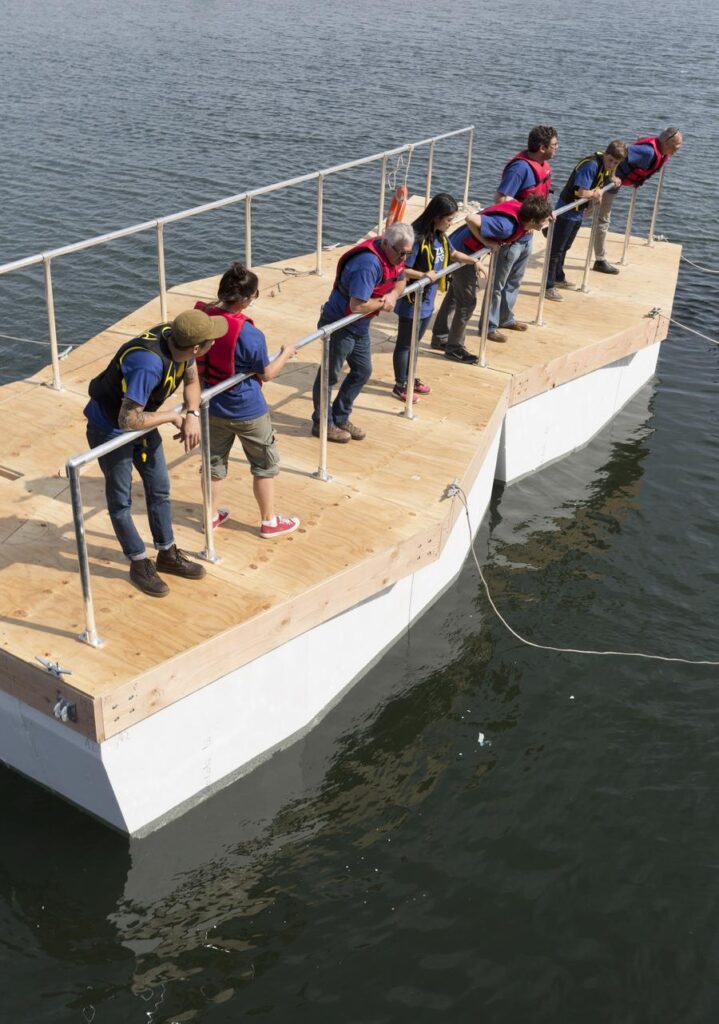
Nancy Nowacek, The Bridge, 2012-2016. Mixed media, various dimensions. Superblock stability test. Image courtesy of the artist.
Nancy’s focus on bodily movement is crucial to her projects’ success in engaging audiences with mixed generations and skill. Walking the Edge (2025) described the less-traveled pedestrian path around Manhattan Island by bringing participants to the margins, literally changing their perspectives of the city.
(Between) Islands (2022-2024) directly took into account various capacities and abilities as a series of intergenerational sculpture and movement workshops. These workshops allowed for meaningful relationships to develop among age groups currently most susceptible to loneliness: teens and adults 65 and older. A novel motivational strategy for strength training framed the workshops linking mental health and physical health. Wouldn’t it be easier to lift weights if my impetus to do so was made palpable? The art aspect of the workshops focused on just that, producing 1 or 2-lb ceramic weights formed in shapes of intention and inspiration; a diploma, sunshine, drawing implements, and candy, among the standouts.
Hauling sandbags, walking, and lifting weights all involve repetition and ease the mind into a meditative state. Nancy does not just bring people together in proximity, but through movement syncs them physiologically.
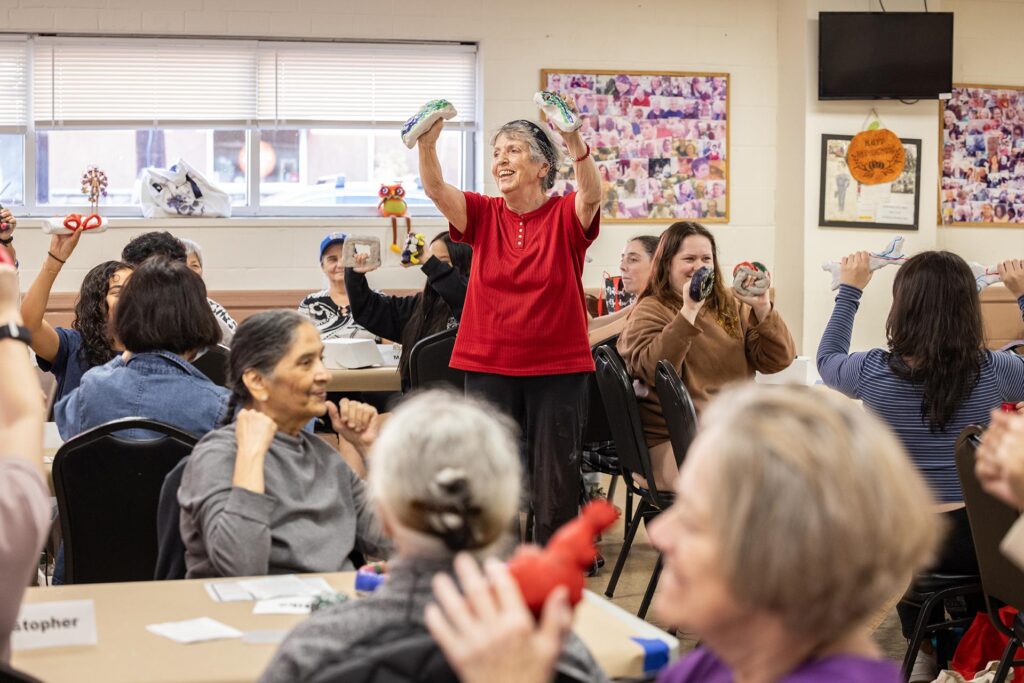
Nancy Nowacek, (Between) Islands, 2022-2024. A participant leads the room in the custom exercises for her weights, Hoboken, Fall 2024. Sculpture and participatory performance. Image courtesy of the artist.
A recent project, Just Crushing (2022-2025), in partnership with Allison Rowe and Midwest high schoolers, shares a similar social ethos and the multi-audience strategies of Maneuver. Where the latter flourished in the traffic of a high density urban park, the former brought her to Iowa, the symbolic center of Middle America. Embedded in America’s heartland, the culture of the demolition derby became a natural container for what Nancy calls her practice of “social prosthetics.”
The artists worked with a group of twenty Iowa City teens over the summers of 2023 and 2024 to design car ornaments for derby vehicles. The summer workshops culminated in a live, five-car demolition derby at the Dubuque County Fair in Dubuque, Iowa, July 2025. The teens were prompted to conceive and execute a paint job composition that promotes an urgent and meaningful political issue. They modeled: a Mitsubishi for Reproductive Rights, a Nissan for Discrimination, A Volkswagen Beetle for Climate Change, a Toyota Camry from Mental Health, and Chrysler Cruiser hatchback for Democracy.
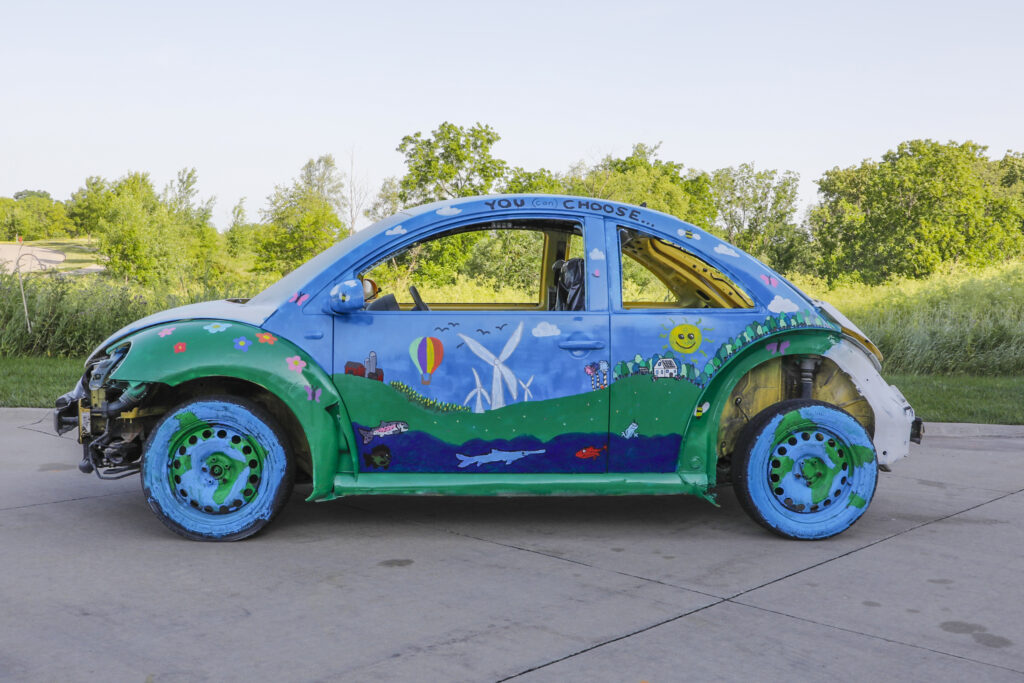
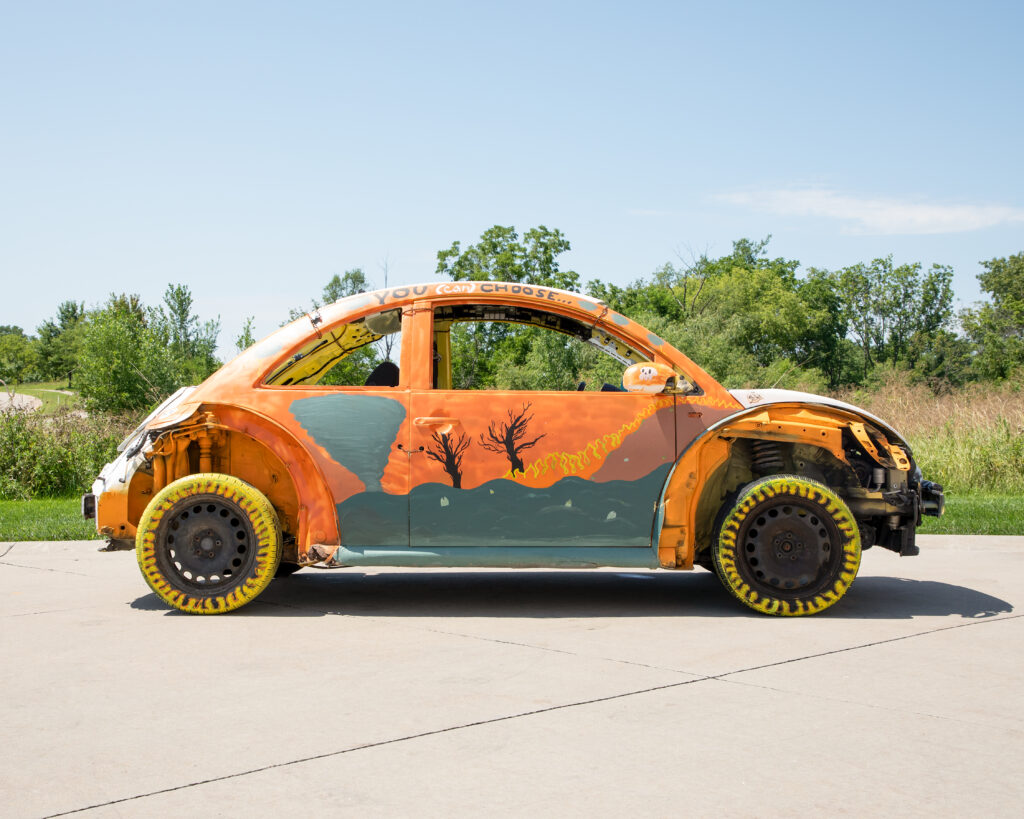
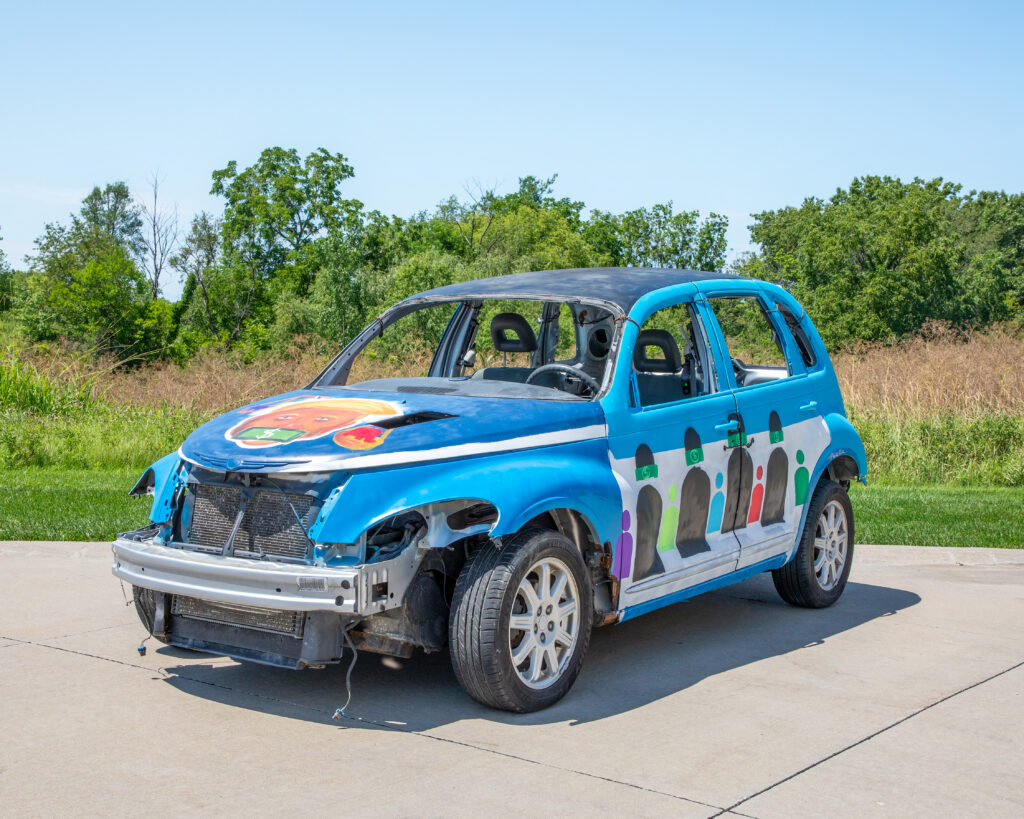
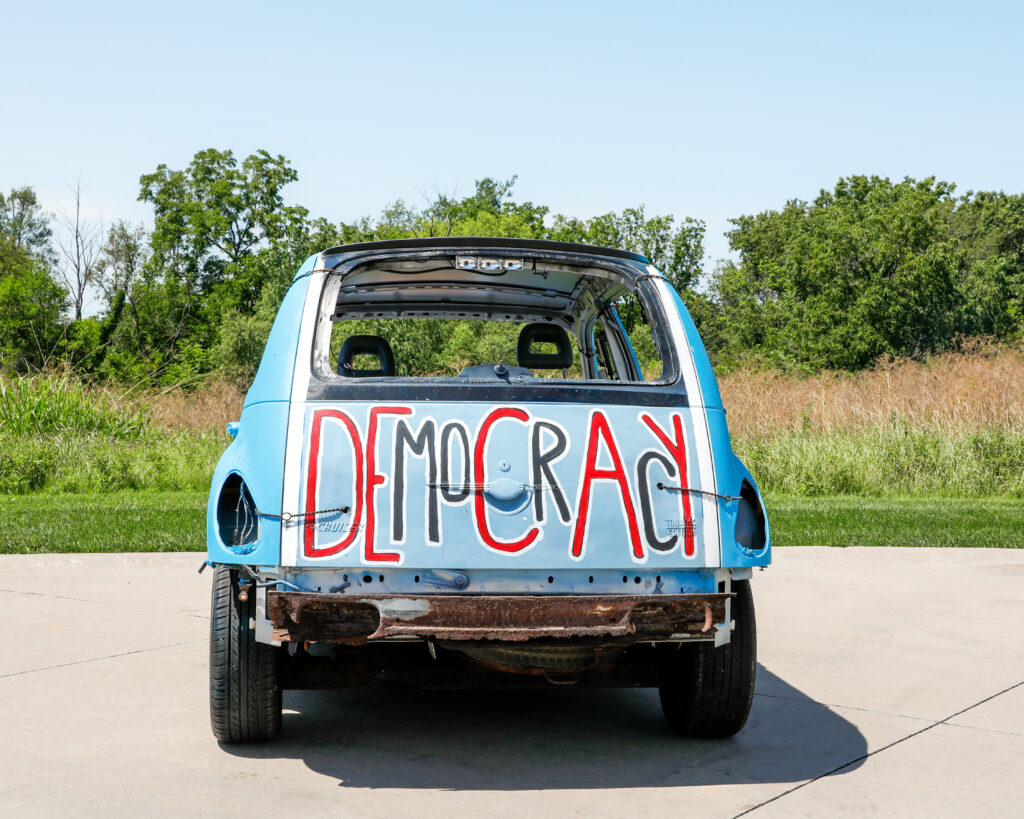
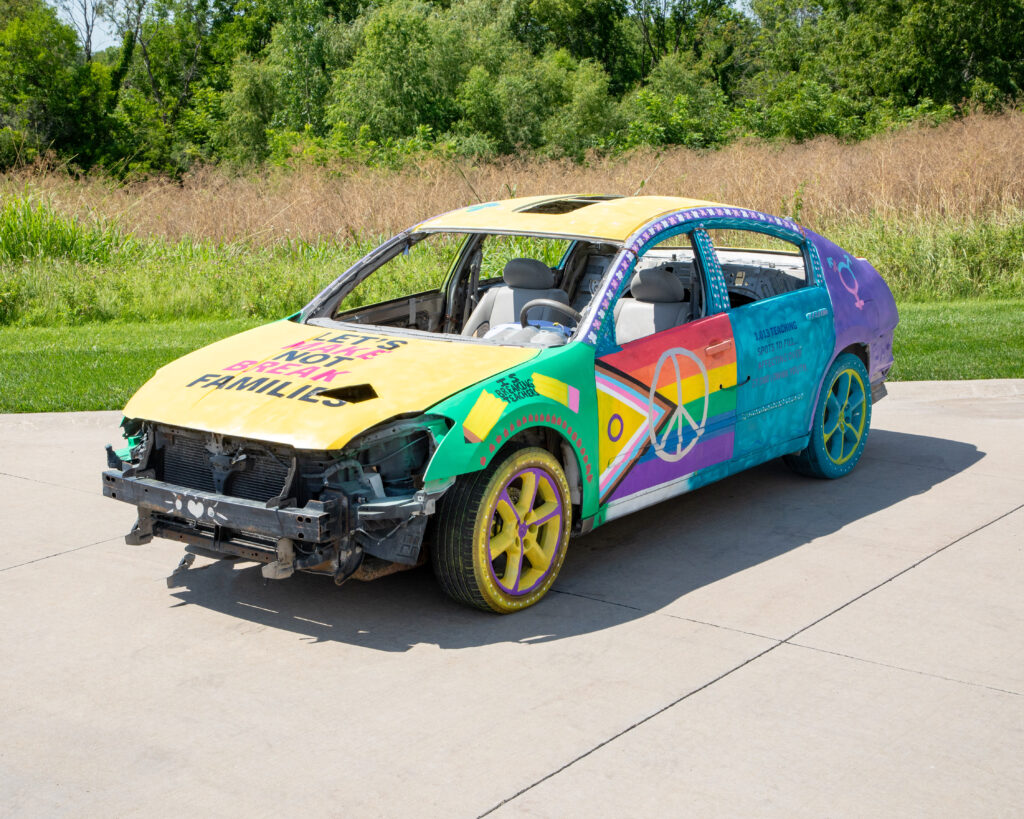
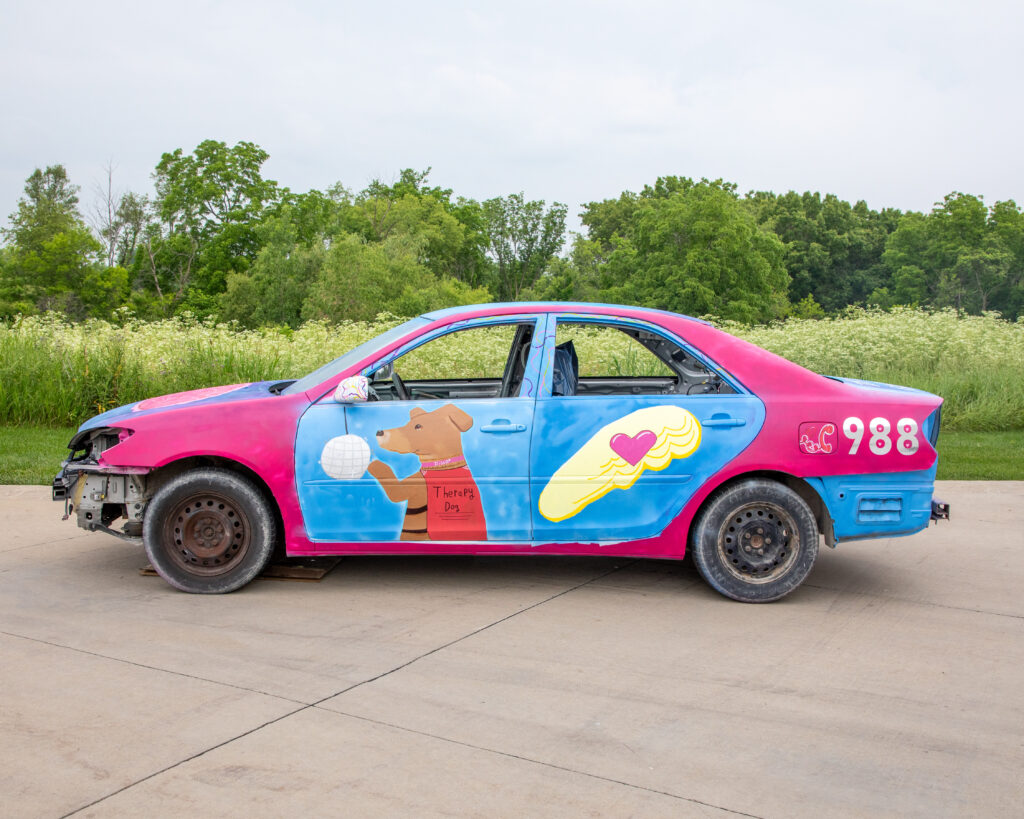
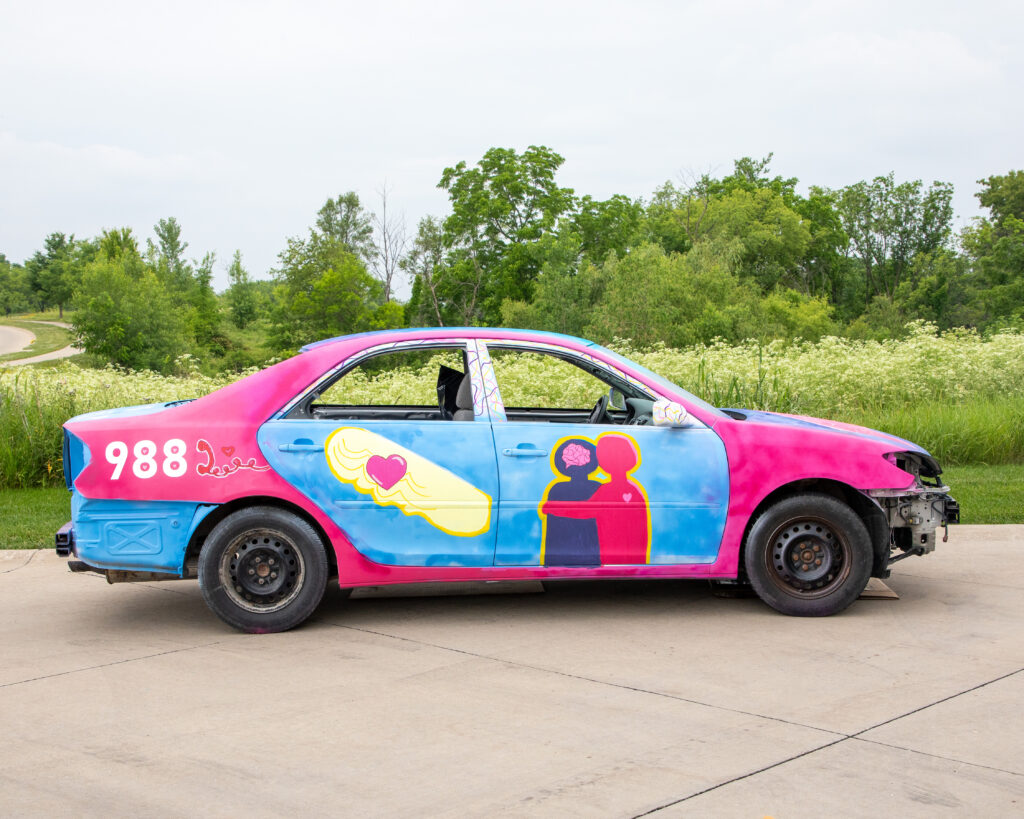
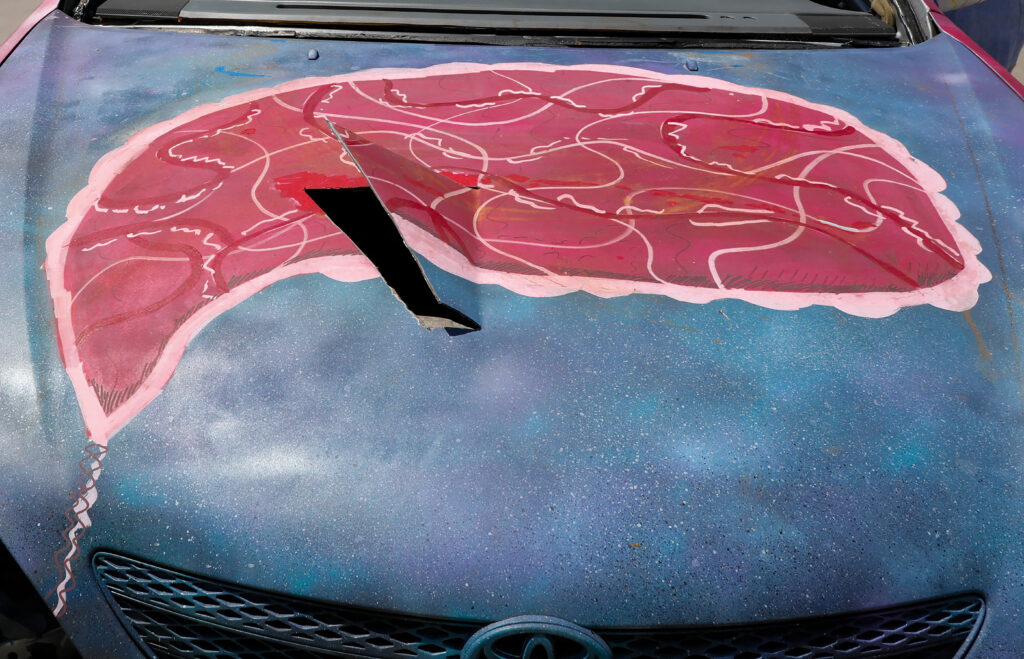
In this political moment, the demolition derby subculture illuminates rural, working-class identity and its resistance to the auto industry’s strategy of planned obsolescence. Historically, the demolition derby’s destruction is highly performative and mirrors consumer culture’s ravenous appetite for the new as older vehicles are altered and prepped for their ritual destruction. The crowd’s collective effervescence and adrenaline release at the spectacle of speed and collision emit an accelerated corporeal beat that reflects the partisan battles, ideological extremism, and social fragmentation.
A video relay of the intricate choreography of the derby aptly serves as allegory for the current moment of national political polarization. It begins with a shot of the cars lining up. An announcer asks the crowd to stand for the Star Spangled Banner. A zoom out reveals the bandstand audience and the group of teens donning matching bright yellow t-shirts with a logo of one car smashing another. The aerial shot is telling: the footprint of the parking lot is larger than the arena. Lines of vehicles shine in neat rows on a carpet of green grass. Low flat warehouse-like buildings surround the arena. A shot of a limp, barely swaying American flag follows. There’s a pan of the stadium, which at two thirds capacity, seems like a big crowd.
The action of the derby, unlike the quick cuts that I’d seen on TV, was not fast at all. There was a lot of driving backwards and around in circles. Wheels spun in clay mud. The first to drop out was Mental Health. Climate Change created chaos until it sputtered to a stop. Democracy’s wheel came off and kept driving. Discrimination and Reproductive Rights ganged up on Democracy. The crowd gave a collective groan. Eventually, Reproductive Rights and Democracy went head to head. There was a loud crack, and despite a smoking motor, Reproductive Rights was the car that came out battered but moving.
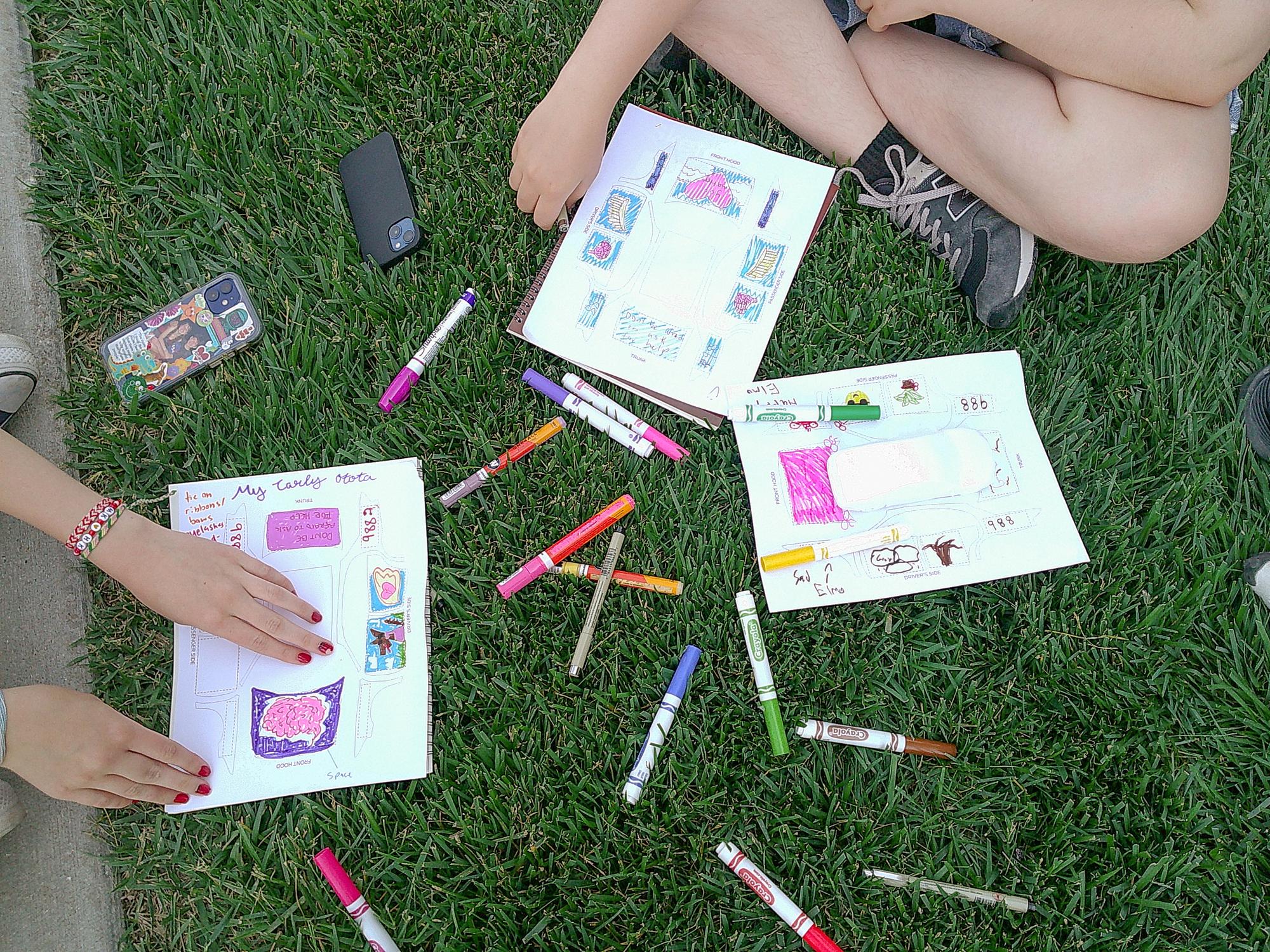
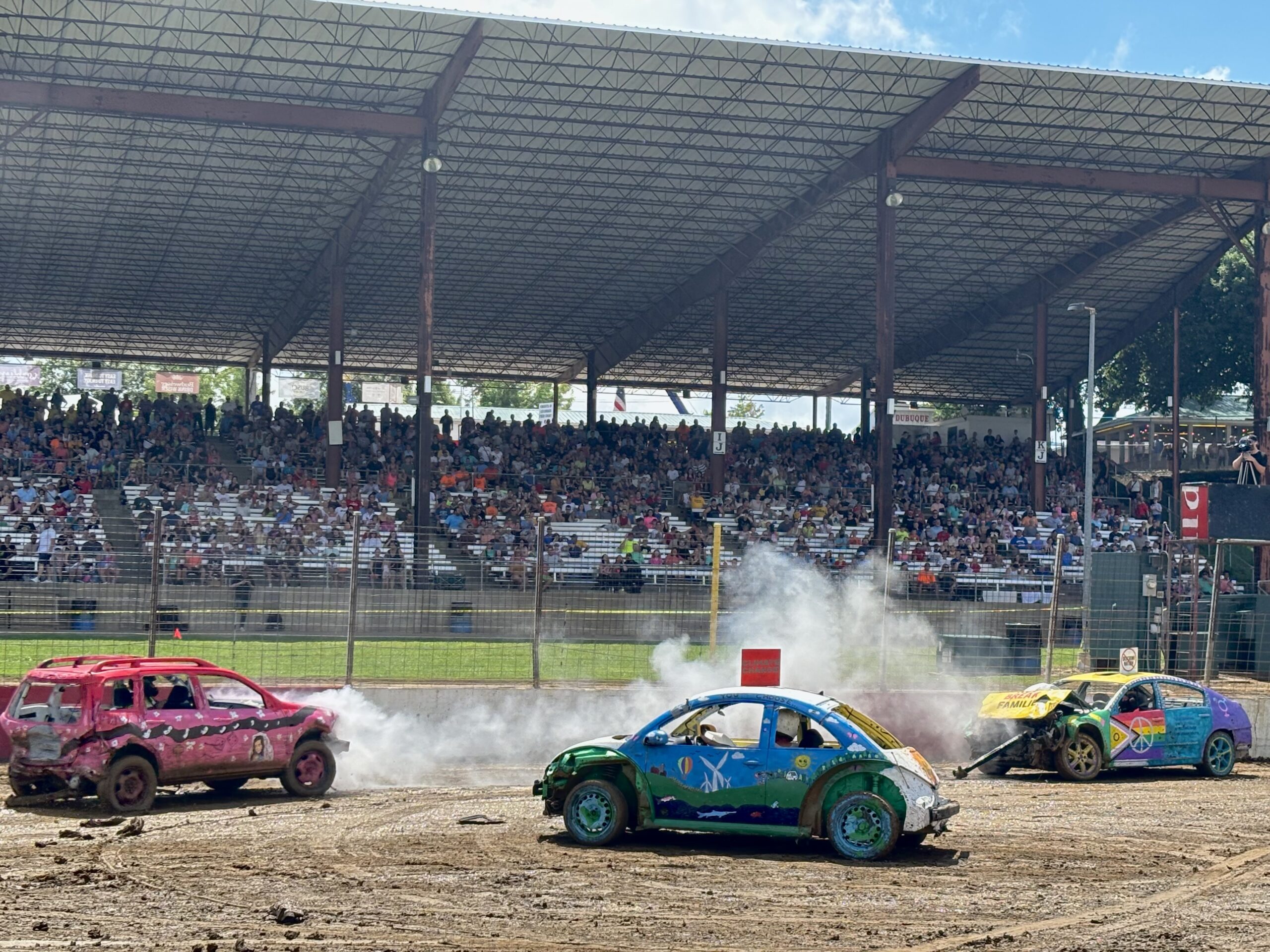
WorkingWorking Group, a collaboration with Allison Rowe, Just Crushing: Art and Civics Camp, 2022-2025.
In contrast with social practice projects that center social or moral efficacy, aesthetics are not secondary or inconsequential to the meaning of Nancy’s projects. Striking colors act as legible signifiers, horizontal orientation suggests non-hierarchy, and movement variables–speed, pacing, endurance–reflect the dynamics of the systems the artist explores.
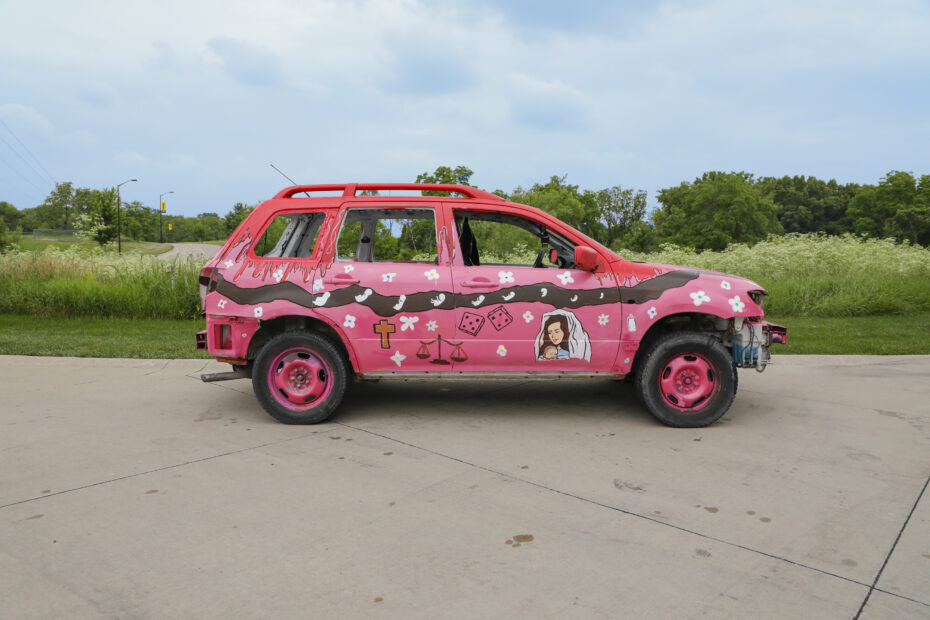
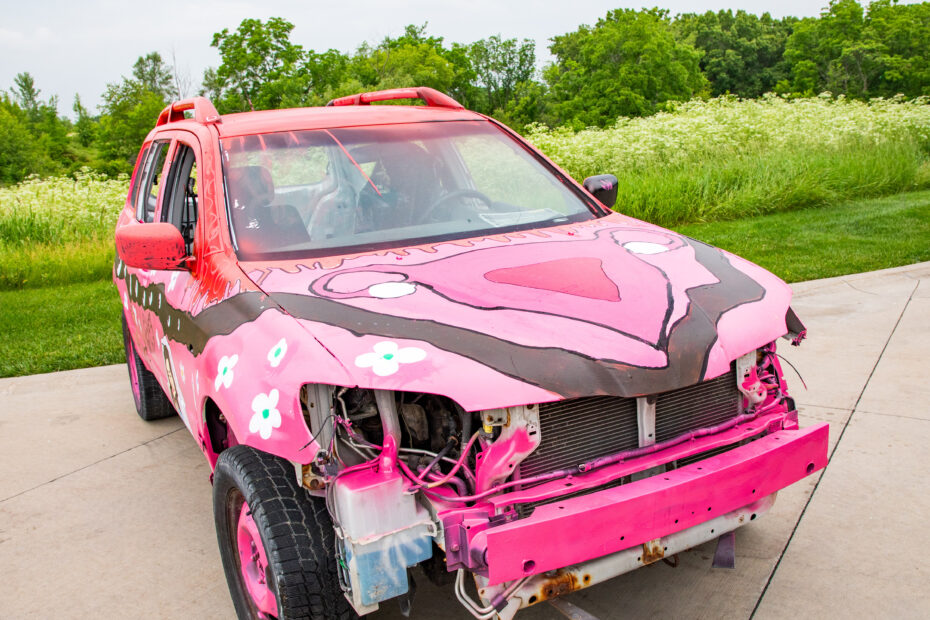
While pink was an obvious background color choice for the Reproductive Rights group, the imagery depicted was not. According to Nancy, only through a series of discussions, transactions and compromises did the teens arrive at a composition which highlighted the broadly symmetrical faceted shape of the car.
Appropriately, the driver’s side roughly encompassed a Pro-Choice stance. Grounding the composition is the slogan, “My Body, My Choice” flanked by a white stick, recognizable as a rapid pregnancy test with its red indicator mark and the T-bone silhouette of an IUD. Above lies a landscape; the city is a jumble of buildings, of which only “the Clinic” is labeled. Dollar bills hover between the clinic and a discernibly separate large hospital building. The passenger’s side disjointedly combines a Christian cross, scales of seemingly even weight, a pair of dice, and the nestled heads of Madonna and baby, seemingly highlighting Anti-Abortion sentiments. A dark stripe, reminiscent of a fallopian tube despite its anatomical inaccuracy, circles the car garland-like, uniting its side. A series of nine little nuggets presents the developmental sequence of fetus to full term baby, from amphibian blob to a defined profile portrait. The flip side illustrates growth joyously with fruit and vegetable size comparisons: blueberry, lime, apple, potato, mango, eggplant, pineapple, and watermelon, punctuated with numbers associated with medical guidelines on abortive procedures. The whole team readily agreed on the gnarly red blood that oozes from the roof down all sides of the car as well as the stark legal fact candidly depicted on the car’s hatchback door: a grave stone marked, “Here Lies Rowe vs. Wade 1973-2002.”
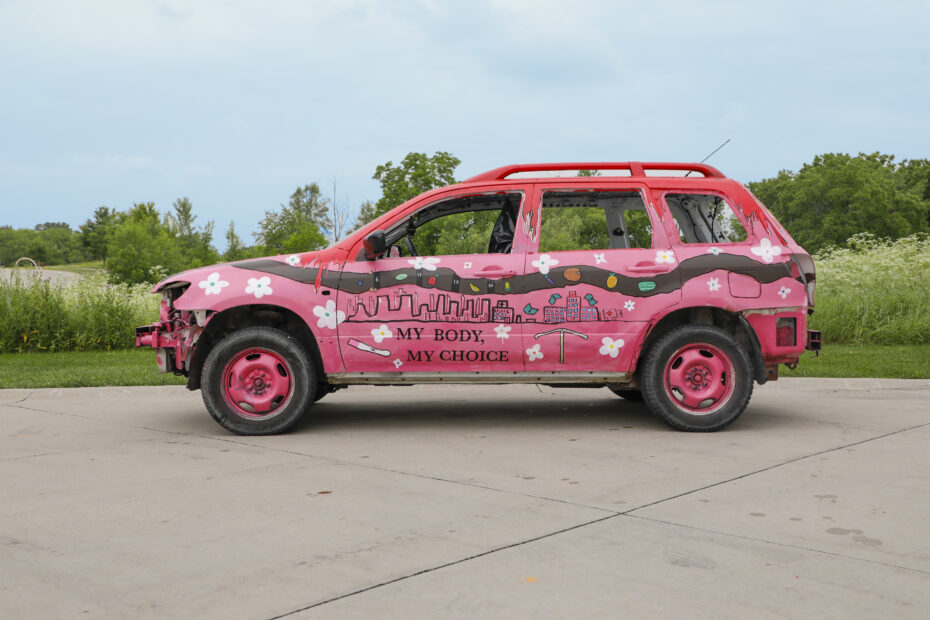
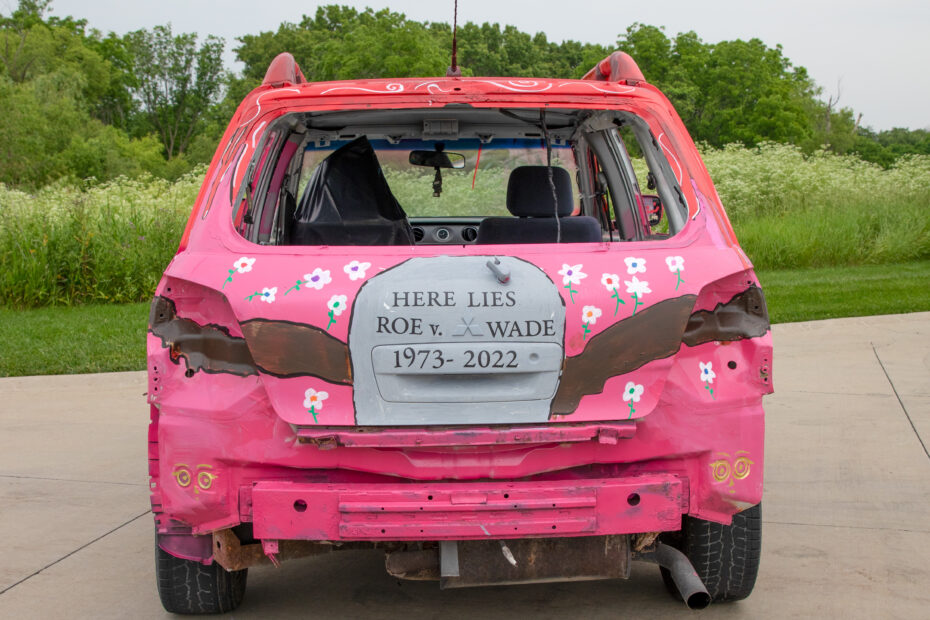
Inspired by the teens’ own negotiating prowess in working on a shared design, Nancy and Allison are preparing the aptly named Concessions project, a video installation that brings rural youth voices into the gallery space. The project will feature video of the derby with captioned commentary by narrators representing four voting demographics. This traveling iteration of the derby is a dual nod to the small business operators selling on the premises of the larger County Fairs and the concessions we all must make to live in community today. What kinds of arts venues, university museums, artist-run spaces, or community organizations, take up this project may be a litmus test of those most willing to tackle the more urgent political divisions of today.
Ultimately, Nancy’s work resists closure and instead favors an open-endedness that mirrors the very systems it engages. Across projects, meaning is not fixed in a final form but emerges through cycles of participation, transformation and dispersal. Whether in the gradual erosion of sand along a shoreline or the erratic collisions of demolition derby, her practice foregrounds process as method and message. In an era defined by political divineness and accelerating environmental precarity, Nancy’s projects offer neither simple solutions nor didactic blueprints. Instead, they model forms of engagement rooted in cooperation, negotiation, and embodied awareness.
Nancy stages situations that necessarily navigate differences across generations, geographies, classes, and ideologies. This work suggests that the bigger picture is not a singular unified vision, but a dynamic and often uneasy coexistence of perspectives. What remains the most compelling is not the temporary structures that she builds, but the lasting impressions of shared effort and critical reflection that they leave behind. These moments quietly insist that meaningful change begins in the ways we move with and alongside one another.
. . .
Written and compiled by Jess Wilcox. Jess is an independent curator based in New York City and the Hudson Valley. She has a focus on sculpture, ecocrticial and public art.
Nancy Nowacek
2024 Corrina Mehiel Fellow Meet Nancy: (she/they) I am an interdisciplinary artist interested in social infrastructures. I make installations, sculptures, drawings, photographs, video, sound, and participatory works to activate social change. These works are often site-specific and employ writing, typography, symbolic languages, images, and/or found objects as material. A background in design informs the problem-seeking nature of my process and the visual quality of my work. My practice is research-based and